

CG Policy · 2025
In this section7 topics
Corporate Governance Policy
Has a Corporate Governance Policy
Yes
Policy Description
Euro Creations Public Company Limited ("the Company") places importance on good corporate governance as the foundation for long-term value creation and sustainability. The Board of Directors is committed to setting direction and overseeing business operations in accordance with the Corporate Governance Code for Listed Companies 2017 (CG Code) of the Securities and Exchange Commission (SEC) and the Stock Exchange of Thailand (SET), as well as the assessment criteria under the Corporate Governance Report of Thai Listed Companies (CGR) programme of the Thai Institute of Directors (IOD) — to ensure that operations are conducted efficiently, transparently, and with accountability.
The Board of Directors has established written good corporate governance policies and practices, including a Good Corporate Governance Policy, a Code of Business Ethics, and other relevant governance policies. The Nomination and Remuneration Committee is responsible for presenting these policies to the Board of Directors for consideration and approval. Such policies and practices are reviewed regularly at least once a year, with the most recent review conducted on 14 November 2025.
To elevate operational standards in accordance with good corporate governance principles and promote their genuine implementation throughout the organisation, the Company communicates and provides knowledge of these policies and practices to directors, executives, employees, stakeholders, and all relevant parties through various appropriate channels, including the Company's website, Microsoft Teams, the employee handbook, and the Humansoft application.
The Company's Good Corporate Governance Policy encompasses all eight principles as follows:
Roles and responsibilities of the Board of Directors
Corporate objectives and primary goals
Strengthening Board effectiveness
Recruitment and development of senior executives and personnel management
Promoting innovation and responsible business conduct
Ensuring appropriate risk management and internal control systems
Maintaining financial credibility and information disclosure
Supporting shareholder engagement and communication
Policy Document Link
https://www.ir.eurocreations.co.th/storage/corporate-governance/cg-policy/euro-cg-policy-th.pdf
Policy & Practices — Board of Directors
Has Policy & Guidelines for the Board
Yes
Board Guidelines
| Guideline | Other — Please Specify | Detail | Document Link | Page Number in Report | ||||||||||||||
|---|---|---|---|---|---|---|---|---|---|---|---|---|---|---|---|---|---|---|
| Nomination of Directors | The Company has a systematic, transparent, and accountable process for the nomination and appointment of directors, encompassing the consideration and verification of candidates' qualifications against defined criteria, the assessment of necessary diversity and specialist expertise, and the submission of appointment proposals in accordance with relevant authority — the key steps of which are summarised as follows.
| https://www.ir.eurocreations.co.th/storage/corporate-governance/cg-policy/euro-cg-policy-th.pdf | 4-7 | |||||||||||||||
| Determination of Director Remuneration | The Board of Directors has delegated to the Nomination and Remuneration Committee the responsibility for establishing a framework and approach for the consideration of remuneration for the Board of Directors, sub-committees, and the President — based on principles of transparency, appropriateness, and alignment with the roles, responsibilities, and accountabilities of each position. In considering the remuneration of the Board of Directors and sub-committees, the Nomination and Remuneration Committee takes into account the business context and the Company's operating performance, alongside the overall economic environment and remuneration benchmarks of companies in the same industry — with the aim of establishing a remuneration structure that appropriately reflects the responsibilities and duties of directors, and is sufficient to motivate directors to perform their roles effectively and to support the organisation in achieving its strategic objectives in both the short and long term. Once the Nomination and Remuneration Committee has completed its deliberations, it will submit its recommendations to the Board of Directors for further consideration and review, prior to presentation to the shareholders' meeting for approval. | https://www.ir.eurocreations.co.th/storage/corporate-governance/cg-policy/euro-cg-policy-th.pdf | 5 | |||||||||||||||
| Independence of the Board of Directors from the Management | To strengthen good corporate governance and operational transparency, the Company has designated the Chairman of the Board as a separate individual from the President (the Company's highest-ranking executive) and the Chief Executive Officer. The Company has clearly separated the roles and authority of the Chairman of the Board and the President (senior executive) to ensure appropriate checks and balances and to support sustainable business operations. The Board of Directors has clearly defined the duties, responsibilities, and scope of authority of each position without overlap. Role of the Chairman of the Board The Chairman of the Board plays an important role in overseeing the performance of the Board of Directors, with a focus on enabling the Board to fulfil its duties effectively and achieve defined objectives, as well as serving as chair at Board of Directors' meetings to ensure that deliberation and decision-making processes are thorough and conducted with the best interests of the Company in mind. In addition, the Chairman serves as a liaison mechanism between the Board of Directors and management, providing strategic guidance and monitoring and evaluating management's performance in alignment with the Company's direction and strategy. Role of the President (Senior Executive) The President is responsible for managing and operating the Company's business at an operational level under policies and strategies approved by the Board of Directors, with a focus on managing performance in both the short and long term, alongside identifying and developing new business opportunities to support the Company's sustainable growth. The President is also responsible for regularly reporting operating results to the Board of Directors, providing accurate and complete information to enable the Board to monitor and evaluate performance effectively. Mechanism for Strengthening Checks and Balances The Board of Directors has appointed the Chairman of the Audit Committee and Independent Director (Mr. Pornthep Srisaan) as Lead Independent Director — to jointly participate in setting the Board of Directors' meeting agenda and to promote checks and balances between the Board of Directors and management, serving as an important mechanism for building confidence among shareholders and stakeholders. | https://www.ir.eurocreations.co.th/storage/corporate-governance/cg-policy/euro-cg-policy-th.pdf | 6 | |||||||||||||||
| Director Development | The Company promotes and supports continuous training and knowledge development for directors to strengthen their knowledge, understanding, and ability to perform their duties effectively. Directors are provided with opportunities to attend training sessions and seminars organised by the Thai Institute of Directors (IOD) or external organisations, as well as internal Company activities and visits to affiliated companies or customers, as appropriate and in accordance with each director's interests. New Director Orientation For new directors, the Company places importance on preparing them to fulfil their duties promptly and effectively. The Company Secretary will provide essential documents necessary for the performance of their duties, including the Director Handbook, Good Corporate Governance Policy, Code of Business Ethics, Articles of Association, description of business operations and operating results, as well as relevant laws and regulations. In addition, management will conduct an orientation for new directors by introducing them to the executive team, the Company's operational structure, and arranging a site visit — to build an in-depth understanding of the Company's business, direction, and operational approach. | https://www.ir.eurocreations.co.th/storage/corporate-governance/cg-policy/euro-cg-policy-th.pdf | 7 | |||||||||||||||
| Board Performance Evaluation | The Board of Directors requires that performance evaluations of the Board of Directors, sub-committees, individual directors, and the President be conducted at least once a year — to review operating results, identify areas for improvement, and continuously enhance work effectiveness. The Company has established clear evaluation criteria and regularly reviews them to ensure alignment with appropriate best practices. | https://www.ir.eurocreations.co.th/storage/corporate-governance/cg-policy/euro-cg-policy-th.pdf | 7 | |||||||||||||||
| Corporate Governance of Subsidiaries and Associated Companies | The Board of Directors has established a systematic governance framework for overseeing investments and the management of subsidiaries and affiliated companies, to ensure that operations are conducted in accordance with applicable laws, regulations, and the Company's strategic direction — with emphasis on appropriate governance at the policy, management, and internal control levels. The Company will consider, select, and appoint individuals with appropriate knowledge, expertise, and experience to serve as directors or executives in subsidiaries and affiliated companies, taking into account shareholding proportions — to strengthen the effectiveness of oversight and performance monitoring. Such appointments are subject to consideration by the Board of Directors or are made in accordance with delegated authority. In addition, the Board of Directors has established clear conflict of interest prevention measures, alongside the implementation of systems for monitoring and periodically reporting the operating results, financial position, and internal control effectiveness of subsidiaries and affiliated companies to the Board of Directors — to ensure that operations are transparent, accountable, and in compliance with applicable financial reporting standards. | https://www.ir.eurocreations.co.th/storage/corporate-governance/corporate-policies/euro-investment-and-management-policy-th.pdf | ||||||||||||||||
| Other guidelines regarding the board of directors | Directorship in Listed Companies | The Company's corporate governance policy clearly stipulates that directors and executives of the Company may hold positions as directors or executives of affiliated companies or other companies, provided that such appointments do not impede the performance of their duties as directors and are in compliance with the requirements of the SEC, the Capital Market Supervisory Board, and the SET, as well as other requirements applicable to business operations on the Stock Exchange. The Company requires that each director and executive hold directorships in no more than five listed companies, to ensure that directors are able to dedicate sufficient time and attention to the performance of their duties and to oversee the Company's business operations effectively. All current directors strictly comply with this policy to ensure that each is able to participate fully in decision-making and governance. In 2025, no director held a directorship in more than five listed companies. | https://www.ir.eurocreations.co.th/storage/corporate-governance/cg-policy/euro-cg-policy-th.pdf | 5 | ||||||||||||||
| Other guidelines regarding the board of directors | Board of Directors' Meeting | The Board of Directors places importance on fulfilling its roles and responsibilities by attending meetings regularly to monitor and oversee the Company's operations. The Company has established clear guidelines for Board of Directors' meetings as follows.
| https://www.ir.eurocreations.co.th/storage/corporate-governance/cg-policy/euro-cg-policy-th.pdf | 6 | ||||||||||||||
| Other guidelines regarding the board of directors | Succession Plan | The Board of Directors places importance on the development of senior executives and the preparation of a Succession Plan to ensure business continuity, delegating to the Nomination and Remuneration Committee the responsibility for defining and overseeing the succession plan for the positions of President and management. The selection process takes into account suitability in terms of qualifications, knowledge, capabilities, and work experience. The Company prepares successors through a systematic development process — including training and job rotation — to strengthen skills and readiness for the assumption of responsibilities, and to mitigate risks arising from future management changes. The President is responsible for reporting progress and performance against the succession plan to the Nomination and Remuneration Committee and the Board of Directors on a periodic basis, at least once a year. In 2025, the President reported progress on the succession plan to the Nomination and Remuneration Committee and the Board of Directors at the Nomination and Remuneration Committee Meeting No. 2/2025 and the Board of Directors' Meeting No. 5/2025, held on 14 November 2025. | https://www.ir.eurocreations.co.th/storage/corporate-governance/corporate-policies/euro-succession-plan-policy-th.pdf | |||||||||||||||
| Other guidelines regarding the board of directors | Term of Office of Independent Directors | The Company has established criteria regarding the term of office of independent directors, stipulating that they may serve in consecutive terms not exceeding nine years in total — to preserve independence in the performance of their duties and to strengthen corporate governance effectiveness. In 2025, no independent director served for a period exceeding nine years. | https://www.ir.eurocreations.co.th/storage/corporate-governance/cg-policy/euro-cg-policy-th.pdf | 5 |
Code of Conduct
Has a Business Code of Conduct
Yes
Code of Conduct Description
The Company conducts its business on the foundation of integrity, transparency, and accountability — upholding ethics and moral principles as the cornerstone of its direction and operations to support stable and sustainable business growth. The Company has therefore established a written Code of Business Ethics and disseminated it through internal communication channels and the Company's website, to serve as a framework for directors, executives, and employees at all levels in conducting their work and making appropriate decisions.
The Company has established measures to actively promote and oversee compliance with the Code of Business Ethics through continuous communications and awareness-building initiatives — to instil an organisational culture that places correctness, transparency, and accountability as its primary values. The Board of Directors reviews and updates the Code of Business Ethics regularly, at least once a year, with the most recent review conducted on 14 November 2025 — to ensure alignment with the business context, applicable laws, and good corporate governance practices, with reference to the Corporate Governance Code (CG Code) 2017 of the SEC.
In conducting its business, the Company places importance on strict compliance with all applicable laws and requirements, covering key matters such as the respect for human rights, prevention of fraud and corruption, avoidance of conflicts of interest, and prevention of insider trading — to build confidence among customers, partners, and all stakeholders.
In addition, the Company places importance on personal data protection by establishing data security measures and appropriate management of customer and employee data, alongside conducting business with regard to social and environmental impact, promoting efficient resource use, and reducing the potential impact of its operations.
The Board of Directors is responsible for overseeing that the Company's business operations are conducted in strict accordance with the defined Code of Business Ethics and governance principles — to build confidence among all stakeholder groups and reinforce the Company's commitment to conducting business responsibly, transparently, and with unwavering adherence to ethical principles.
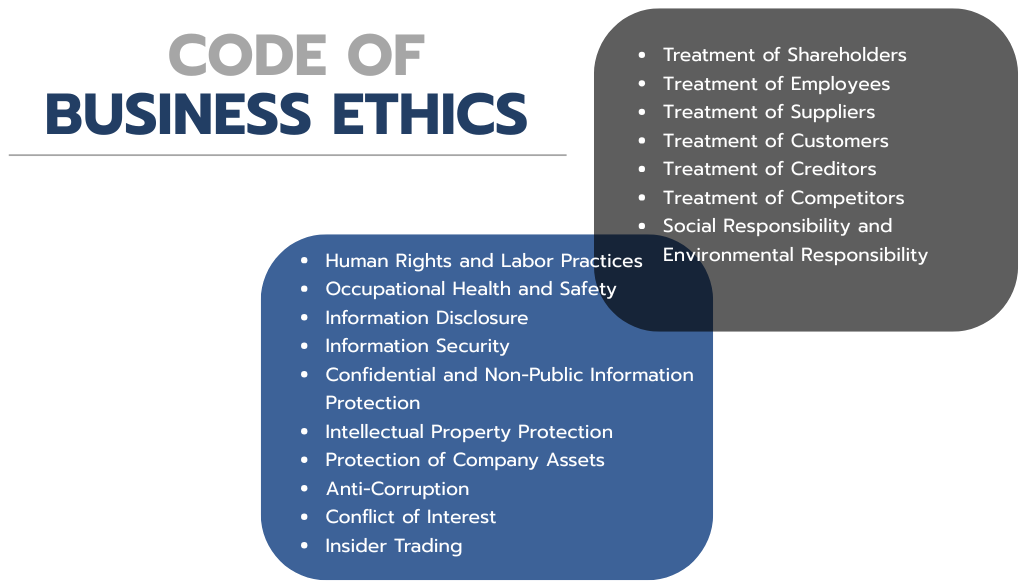
Code of Conduct Link
https://www.ir.eurocreations.co.th/en/corporate-governance/code-of-conduct
Code of Conduct Practices
| Guideline | Other — Please Specify | Detail | Document Link | Page Number in Report | ||||||||||
|---|---|---|---|---|---|---|---|---|---|---|---|---|---|---|
| Prevention of Misuse of Inside Information | The Company places importance on preventing conflicts of interest, and has therefore established clear written policies and practices for conflict of interest prevention, covering directors, executives, and employees at all levels. Policies and Practices 1. Directors and executives must not engage in businesses that compete with the Company and its subsidiaries, or become partners, decision-making shareholders, directors, or executives in such businesses — whether for personal benefit or the benefit of others. However, if such positions were held prior to becoming a director or executive of the Company, and were reported to the Board of Directors' meeting or shareholders' meeting prior to appointment, an exemption may be granted. 2. Directors and executives should disclose to the Company any business transactions or business activities of themselves, their families, relatives, or dependants that may give rise to a conflict of interest with the Company and its subsidiaries. 3. Directors and executives are required to disclose and submit information regarding their own interests and those of related persons to the Company Secretary using the prescribed form. The Company Secretary will forward such reports to the Chairman of the Board and the Chairman of the Audit Committee within seven business days, or immediately prior to the approval of any transaction — to ensure awareness of relationships and transactions that may give rise to a conflict of interest with the Company and its subsidiaries. 4. Directors, executives, and employees must not seek personal gain or benefit for others, and must not use the Company's assets or confidential and undisclosed information — such as plans, revenues, board resolutions, or business projections — for any purpose. 5. Directors, executives, and employees must prioritise the interests of the Company and its subsidiaries, and must not make decisions or approve transactions in which they or their close relatives have an interest or conflict of interest. Any employee with an interest in a transaction must report this to their supervisor immediately. 6. Directors, executives, and employees must not play any role in recruitment decisions involving persons related to themselves, to ensure that the consideration process is transparent and fair. 7. The Company will communicate and provide knowledge to directors, executives, and employees regarding the conflict of interest prevention policy on an annual basis through various channels, including the Company's website, email, and Microsoft Teams. In addition, any director with an interest in a particular agenda item has no right to vote and must leave the meeting room during the consideration of that item — to allow the meeting to deliberate freely. | https://www.ir.eurocreations.co.th/storage/corporate-governance/corporate-policies/euro-conflict-of-interest-policy-th.pdf | ||||||||||||
| Anti-corruption | The Company recognises the importance of combating corruption and fraud in all forms, and is committed to conducting its business with honesty, transparency, and fairness under good corporate governance principles — with regard to business ethics and ethical principles alongside responsibility towards society, the environment, and all stakeholder groups. The Company has therefore established a written Anti-Corruption Policy to serve as an operational guideline for directors, executives, and employees at all levels — forming a critical foundation for driving the organisation towards sustainable growth. The policy defines an appropriate framework of responsibilities, practices, and control measures to build an organisational culture of zero tolerance for corruption and to reduce risks arising from business activities, ensuring that decisions and operations at all levels are conducted with care, accountability, and in compliance with applicable laws. Policies and Practices 1. Directors, executives, and employees of the Company and its subsidiaries (if any) must not demand, engage in, or accept corruption in any form — whether directly or indirectly — whether for the benefit of the organisation, themselves, family members, friends, close associates, or for business purposes. This applies to all businesses in all countries and all relevant units of the Company and its subsidiaries (if any). Forms of corruption are defined as follows:
2. All business operations and procurement activities must be conducted transparently, honestly, and in accordance with applicable laws. 3. The Company and its subsidiaries (if any) must regularly review compliance with this Anti-Corruption Policy, and must review practices and operational requirements to ensure alignment with changes in business, regulations, and applicable laws. Any breach involving support, facilitation, or cooperation with corruption shall be subject to disciplinary action in accordance with the Company's and/or subsidiaries' regulations (if any). 4. Directors, executives, and employees must not ignore acts that may constitute corruption, and are required to report suspicious activities or complaints through the Company's designated channels and to cooperate in any investigation. 5. The Company provides protection and fair treatment to those who refuse to engage in corruption or report suspicious activities, without any negative impact on their employment status — even if such refusal results in the Company losing a business opportunity. 6. The Company conducts a corruption risk assessment at least once a year, with the Risk Management Working Group responsible for conducting the assessment and establishing appropriate risk management measures. The results of such assessments are reported to the Audit Committee and the Board of Directors for their acknowledgement. | https://www.ir.eurocreations.co.th/storage/corporate-governance/anti-bribery-and-corruption/euro-anti-corruption-policy-th.pdf | ||||||||||||
| Whistleblowing and Protection of Whistleblowers | The Company provides a complaint and whistleblowing mechanism to support transparent business operations and to prevent fraud or inappropriate conduct that may arise in operations or in dealings with stakeholders — enabling investigation, correction, and action to be taken fairly and effectively. Policies and Practices 1. Persons Entitled to Submit Complaints or Whistleblowing Reports
2. Matters Subject to Complaint
3. Complaint and Whistleblowing Channels Complainants should provide details of the matter to be reported, together with their name, address, and contact telephone number, and submit through the following channels:
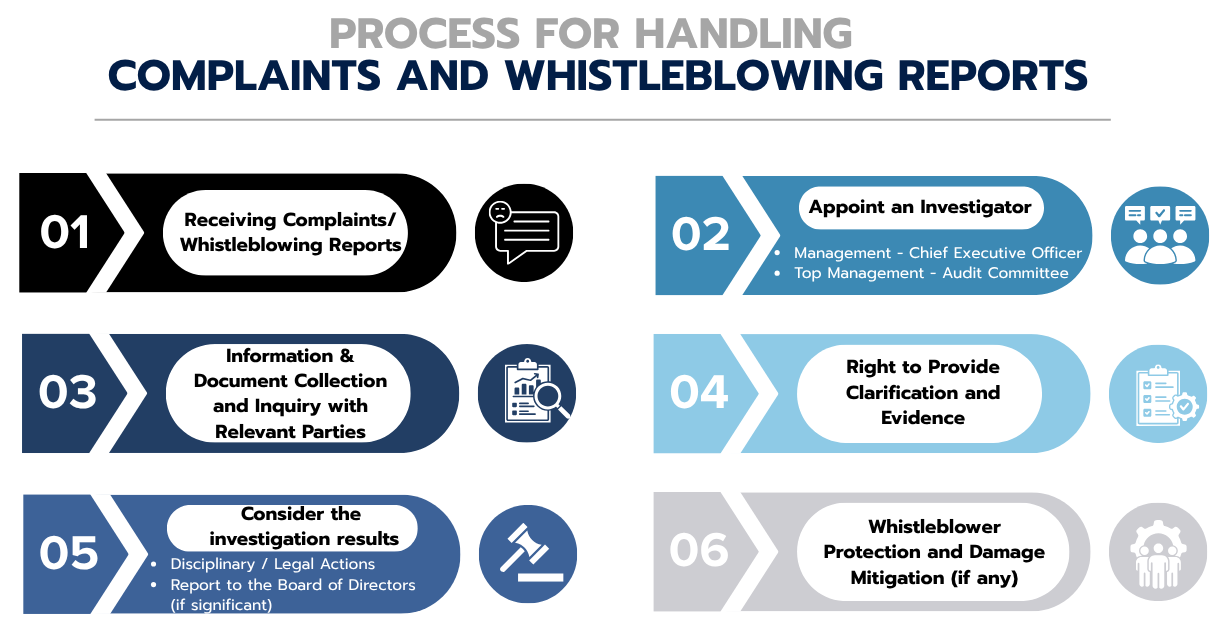
4. Process for Handling Complaints and Whistleblowing Reports Upon receipt of a complaint, the Company will conduct an investigation and gather facts by appointing an appropriate investigator according to the level of the person complained against. Where the person complained against is an executive below the level of CEO, the CEO or a designated representative will conduct the investigation. Where the person complained against is the CEO or a senior executive, the Audit Committee, independent directors, or a designated representative will conduct the investigation. During the investigation, the investigator has the authority to request information, documents, or invite relevant personnel to provide facts, and will report findings to the relevant authority in sequence — to ensure that consideration is thorough and fair. If there are reasonable grounds to believe that a violation has occurred, the person complained against will be notified of the allegations and given the opportunity to respond or present evidence in their defence. Should the investigation confirm that a violation has occurred, the Company will take disciplinary action in accordance with applicable regulations and may pursue legal action as appropriate. If the matter is significant or has a material impact on the Company, the investigator will submit the matter with their opinion to the Board of Directors for further consideration. Furthermore, if the complaint has caused damage to a person who has not committed any wrongdoing, the Company will consider appropriate and fair remedial measures.
5. Whistleblower and Complainant Protection The Company allows complainants to report anonymously, provided that sufficient information or evidence is supplied for consideration. The Company will maintain confidentiality over all complaint-related information and disclose only what is necessary, with regard to the safety and potential damage to the whistleblower and related parties. In cases where the whistleblower may be at risk of harm or damage, the Company will establish appropriate protective measures — either at the whistleblower's request or at the Company's discretion — and will consider fair remedial measures for those affected. The Company does not tolerate retaliation, discrimination, or unfair treatment against complainants, whistleblowers, or those who cooperate in investigations. Any such conduct will be subject to disciplinary action and may result in penalties under applicable laws. 6. Communication The Company continuously communicates and disseminates its whistleblowing and complaint policy to Company personnel through various channels — including orientation, training, internal communications, and electronic systems — to ensure that personnel understand and strictly comply with the policy. In addition, the Company publishes the policy and whistleblowing channels to the public, subsidiaries, and stakeholders through external channels such as the Company's website and the Annual Report (56-1 One Report) — to promote transparency and broad awareness. | https://www.ir.eurocreations.co.th/storage/corporate-governance/anti-bribery-and-corruption/20250307-euro-whistleblowing-policy-th.pdf | ||||||||||||
| Preventing the Misuse of Inside Information | The Company places importance on governing the use of insider information and maintaining the confidentiality of business information — to build transparency, fairness, and confidence among shareholders and all stakeholders. The Company has therefore established clear policies and practices for controlling and preventing the inappropriate use of undisclosed information that may affect the securities price or business operations of the Company and/or its subsidiaries (if any). Policies and Practices 1. Reporting of Changes in Securities Holdings Directors and executives are required to report changes in their holdings of the Company's securities and futures contracts referencing the Company's securities — and those of related persons — to the SEC in accordance with Section 59 of the Securities and Exchange Act B.E. 2535 (as amended), and to submit such reports to the Company Secretary for reporting to the Board of Directors for acknowledgement. 2. Prohibition on Insider Trading Directors, executives, employees, and subsidiaries (if any) who are in possession of insider information must refrain from trading the Company's securities and must not use or disclose insider information for personal gain until such information has been disclosed to the public. The Company designates a Blackout Period of at least 30 days prior to the disclosure of financial statements, and within 24 hours following such disclosure. The Company Secretary will notify all relevant persons on a quarterly basis. 3. Safeguarding of Insider Information
4. Communication The Company will communicate and provide knowledge to directors, executives, and employees regarding the insider information policy on an annual basis through various channels, including the Company's website, email, and Microsoft Teams. 5. Penalties
| https://www.ir.eurocreations.co.th/storage/corporate-governance/corporate-policies/euro-insider-trading-policy-th.pdf | ||||||||||||
| Prevention of money laundering | The Company places importance on the prevention of money laundering, establishing appropriate practices to control risks arising from business operations and financial transactions — to ensure that all activities are conducted transparently and in compliance with applicable laws. | |||||||||||||
| Giving or receiving gifts, entertainment, or business entertainment | The Company has established a clear framework governing the giving and receiving of gifts, entertainment, and business hospitality — to support transparent and fair business operations under its Anti-Corruption Policy. Such activities must be conducted appropriately, openly, and with accountability, without giving rise to conflicts of interest or affecting the independence of business decision-making. The Company is committed to strict compliance with all applicable laws and relevant policies — to uphold ethical standards and maintain the confidence of all stakeholders. | https://www.ir.eurocreations.co.th/storage/corporate-governance/anti-bribery-and-corruption/euro-anti-corruption-policy-th.pdf | ||||||||||||
| Compliance with laws, rules and regulations | The Company is committed to conducting its business within a good corporate governance framework, placing importance on strict compliance with all applicable laws, regulations, and rules. The Company has established clear policies, criteria, and practices to promote integrity, transparency, ethical conduct, and appropriate business standards among directors, executives, and employees at all levels. | |||||||||||||
| Use and maintenance of data and assets | The Company places importance on the appropriate and secure use, maintenance, and protection of organisational assets and information, establishing clear policies, measures, and practices to prevent the inappropriate use of the Company's assets, as well as unauthorised access, use, or disclosure of information. Directors, executives, and employees at all levels are responsible for using the Company's assets and information responsibly, with care, and solely for the benefit of the organisation — maintaining the confidentiality of business information, customer data, partner data, and information relating to other stakeholders, and strictly complying with the Company's information security, data protection, and confidentiality policies. The Company is committed to preventing damage, risks, and impacts that may arise from the inappropriate use or handling of assets and information — to protect the interests of the Company and build confidence among all stakeholder groups. | https://www.ir.eurocreations.co.th/storage/corporate-governance/code-of-conduct/euro-code-of-conduct-th.pdf | 7 | |||||||||||
| Anti-competitive | The Company is committed to conducting its business under the principles of free, fair, and transparent competition — strictly complying with trade competition laws and all applicable regulations, while avoiding actions that may create unfair competitive advantages, distort market competition mechanisms, or affect the reputation, rights, or interests of business competitors. Directors, executives, and employees must conduct all business activities on the basis of accurate information obtained lawfully and ethically — to ensure that business operations are conducted transparently, fairly, and in a manner that promotes sustainable and fair competition. | https://www.ir.eurocreations.co.th/storage/corporate-governance/code-of-conduct/euro-code-of-conduct-th.pdf | 10 | |||||||||||
| Cyber security | Information Technology Governance, Cybersecurity, and Business Continuity Management The Company places importance on information technology management, data security, and business continuity — as these are key factors supporting operational effectiveness and reducing organisational risk. The Board of Directors and management are responsible for defining guidelines, overseeing, and monitoring operations in these areas in alignment with the Company's strategy and overall risk management framework. Status updates and key issues are reported to management and the Board on a regular annual basis. 1. IT Governance The Company establishes policies and guidelines for the use of information technology, encompassing data and cybersecurity, cookie policy, and privacy policy — published on the Company's website — to ensure that investment in and use of technology is appropriate, cost-effective, and supportive of efficient business operations. Roles and responsibilities of relevant parties are clearly defined, and IT progress and risks are reported to management on a regular basis. In terms of IT General Controls (ITGC), the Company has established a control framework encompassing Access Management, with the Authorization Matrix reviewed and updated on an annual basis — to ensure that each employee's access rights to data and systems are appropriate to their roles and responsibilities, consistent with the principle of Segregation of Duties, and to prevent unauthorised access. In addition, the Company's IT management is integrated with enterprise risk management to enable the appropriate identification, assessment, and monitoring of risks relating to information systems and technology use. 2. Information and Cyber Security The Company establishes information and information system security policies to prevent unauthorised access to or use of data, and to reduce risks that may affect operations and stakeholder confidence. Access rights are controlled in accordance with employees' roles and responsibilities, with anomaly detection and prevention measures in place, as well as appropriate cyber incident response processes. In addition, the Company continuously promotes knowledge and awareness of information and cybersecurity among all employees through training and educational activities. In 2025, 287 employees out of a total workforce of 331 participated in training, representing 87% of all employees. The outcomes of such training are used to regularly improve security measures. 3. Disaster Recovery The Company has established a Disaster Recovery Plan (DRP) to prepare for events that may affect systems or business operations. These plans cover impact assessment, prioritisation of critical systems, data backup, and system recovery procedures, and are reviewed and tested regularly at least four times per year, as follows:
The results of such tests are evaluated and used to improve the DRP to ensure their appropriateness and effectiveness in responding to emergency situations, as well as alignment with changes in system architecture, technology, and the business environment. 4. Monitoring, Review, and Continuous Improvement The Company regularly monitors and evaluates IT management, cybersecurity, and business continuity — at least once a year — and updates policies and operational guidelines to remain appropriate to changes in technology and the business environment, to ensure the stability and continuity of the Company's operations. | https://www.ir.eurocreations.co.th/storage/corporate-governance/code-of-conduct/euro-code-of-conduct-th.pdf | 6 | |||||||||||
| Environmental management | The Company has established a Sustainability Management Policy to serve as a framework and guideline for conducting business in a balanced and responsible manner, encompassing the environmental, social, and governance (ESG) dimensions in their entirety. The Company is committed to integrating sustainability principles into its operations and business decision-making at every level of the organisation. In the environmental dimension, the Company places importance on efficient resource use, reducing the environmental impact of its operations, appropriate waste management, cost-effective energy and water consumption, and the continuous implementation of measures to reduce greenhouse gas emissions. The Company also seeks to instil environmental awareness among directors, executives, and employees at all levels, while promoting the participation of all stakeholders in the conservation of natural resources. The Company believes that conducting business within this sustainability framework will help create long-term value for the business alongside care for society and the environment — leading to stable and sustainable growth for all stakeholder groups. | https://www.ir.eurocreations.co.th/storage/corporate-governance/code-of-conduct/euro-code-of-conduct-th.pdf | 10 | |||||||||||
| Human rights | The Company conducts its business with integrity and social responsibility, respecting and protecting the human rights of all individuals, treating employees and stakeholders equally, fairly, and with respect for human dignity, while avoiding any actions that may constitute human rights violations in any form. Labour practices are conducted in strict accordance with human rights principles, labour laws, and applicable regulations — covering all employment processes from recruitment and hiring, to compensation determination, through to the provision of a safe and appropriate working environment. The Company does not accept doing business with individuals or organisations involved in child labour, forced or bonded labour, human trafficking, violence, unfair discrimination, below-minimum-wage compensation, or illegal overtime practices. These principles apply to the operations of the Company and its subsidiaries, as well as to partners, business associates, and joint venture partners — to promote responsible and sustainable business conduct. | https://www.ir.eurocreations.co.th/storage/corporate-governance/code-of-conduct/euro-code-of-conduct-th.pdf | 5 | |||||||||||
| Occupational health and safety | The Company places the utmost importance on the health and safety of employees, partners, customers, communities, and all relevant stakeholders — conducting its business in strict compliance with applicable laws, operational frameworks, standards, regulations, and occupational health and safety practices. In its operations, the Company has established security systems, risk prevention and monitoring systems, and effective and adequate warning systems within all offices and business premises under its management — to prevent accidents and emergencies that may affect lives and property. In addition, the Company places importance on health and safety communications and awareness-building, through the dissemination of information, knowledge sharing, and the promotion of health and safety awareness among employees, partners, business associates, customers, communities, and stakeholders through appropriate channels and activities — to support the creation of a safe and sustainable working environment. | https://www.ir.eurocreations.co.th/storage/corporate-governance/code-of-conduct/euro-code-of-conduct-th.pdf | 5 | |||||||||||
| Other guidelines related to business code of conduct | Information Disclosure and Transparency | The Company discloses information accurately, completely, and in a timely manner in accordance with applicable laws and requirements — to ensure that shareholders, investors, and stakeholders receive sufficient and equal access to information. The Company provides appropriate information disclosure channels to strengthen transparency and confidence in its business operations. The Company's website (www.eurocreations.co.th) publishes regularly updated information in both Thai and English, comprising the following key content:
In 2025, the Company conducted a variety of investor relations activities on a continuous basis to meet with and provide information to relevant parties on various occasions, as follows.
|
Promoting Compliance with the Code of Conduct
Promotes Compliance by Directors, Executives and Employees
Yes
Description
The Company is committed to building an organisational culture that upholds integrity and ethics as the foundation of business operations, designating compliance with the Code of Business Ethics as a duty of the Board of Directors, executives, and employees at all levels. The Company places importance on the systematic transfer of knowledge and understanding of business ethics, to enable personnel to apply these principles in their actual work.
The Company's Code of Business Ethics has been prepared and communicated comprehensively through internal media and systems — such as the employee handbook and the Humansoft system — to ensure continuous accessibility and reference. During the past year, the Company reinforced compliance with the Code of Business Ethics among the Board of Directors through meetings and email communications, covering 100% of all directors. Ethics practices were simultaneously communicated and disseminated to executives and employees through the Company's website, Microsoft Teams, and the Humansoft system, with an acknowledgement rate of 100% of all executives and employees.
To support ethics governance, the Company has established a confidential and secure whistleblowing and complaint mechanism, enabling employees to appropriately report conduct that may not be consistent with the Code of Business Ethics — with fair investigation procedures and disciplinary measures in place for cases of violation — to maintain the organisation's business conduct standards.
In addition, the Company regularly monitors and reviews compliance with the Code of Business Ethics, using the outcomes to improve communication and governance approaches in alignment with the changing business context, and to build stakeholder confidence that business operations are conducted transparently and responsibly.
In 2025, the Company recorded no cases of ethical or organisational code of conduct violations.
Process Document Link
https://www.ir.eurocreations.co.th/storage/corporate-governance/code-of-conduct/euro-code-of-conduct-th.pdf
Anti-Corruption Networks & Projects
Joined or Declared Intent to Join Anti-Corruption Networks
No
Networks & Projects Joined
| Network / Project |
|---|
| Thai Private Sector Collective Action Against Corruption: CAC |
| United Nations Global Compact (UNGC) |
| Participation of anti-Corruption networks and initiatives |
Material Changes & Developments in CG
Reviewed the CG Policy or Board Charter in the Past Year
Yes
Material Changes or Developments in the Past Year
Yes
Policy Review — Description
In 2025, the Board of Directors and sub-committees reviewed charters, policies, and practices relating to good corporate governance, with the following key changes and developments.
The Board of Directors approved amendments to the Board of Directors' Charter by adding content regarding the duties of the Chairman of the Board in explicit written form, to ensure alignment with the Corporate Governance Code for Listed Companies 2017 (CG Code).
The Board of Directors approved amendments to three corporate-level governance policies, based on recommendations from the Nomination and Remuneration Committee and the Audit Committee — namely the Good Corporate Governance Policy, the Insider Information Usage Policy, and the Human Resource Management Policy — to update wording and add substantive content in alignment with the requirements of the SEC and the SET, as well as to reflect the Company's current circumstances.
In the past year, the Company recorded no violations of the following matters.
The Company committed no acts in violation of laws or regulations of regulatory authorities resulting in criminal actions, civil sanctions, or administrative actions.
No directors of the Company were subject to news or cases of comparison fines, accusations, or civil proceedings by regulatory authorities.
The Company had no cases of independent directors or non-executive directors resigning due to corporate governance issues, nor any cases of the entire Audit Committee or independent directors resigning en masse.
No directors of the Company committed violations arising from ethics issues contrary to regulations constituting serious offences as determined by regulatory authorities.
The Company submitted no quarterly or annual financial reports late.
The Company received no orders to restate its financial statements from regulatory authorities.
Implements the CG Code for Listed Companies
No
CG Code — Description
In 2025, at Board of Directors' Meeting No. 5/2025 held on 14 November 2025, the Board of Directors conducted an assessment and review of the appropriateness of applying the Corporate Governance Code for Listed Companies 2017 (CG Code) in a manner consistent with the Company's business nature, operational context, and management structure.
For certain principles that have not yet been formally established as policies, or have not yet been fully implemented or applied, management and the Company Secretary reported relevant information and issues to the Board of Directors for consideration, review, and determination of appropriate improvement measures. The CG Code principles that the Company has not yet fully applied are detailed as follows.
CG Code Principle | Company's Rationale or Alternative Measures |
Principle 3.1.3 — The Board should have an appropriate balance between executive and non-executive directors. (a) The majority should be non-executive directors capable of providing independent views on management's performance. (b) The number and qualifications of independent directors should meet the criteria of the SEC and the SET, with independent directors able to work effectively with the full Board and express opinions independently. | The Company has four non-executive directors, representing 50% of the total — equal in proportion to executive directors. The Board considers this proportion appropriate to the Company's business context and nature, as the non-executive directors possess the knowledge and expertise to provide independent opinions and to effectively balance management. In addition, the Company has established supplementary measures to support independent oversight — such as appointing independent directors to key sub-committees and providing opportunities for non-executive directors to express independent views at meetings. The Board will continue to review Board composition regularly in alignment with best practices. |
Principle 3.2.1 — The Chairman of the Board should be an independent director. | Although the Chairman of the Board is not an independent director, the Board of Directors has appointed the Chairman of the Audit Committee — who is an independent director — to participate in determining the Board of Directors' meeting agenda, to strengthen checks and balances and support good corporate governance. |
Principle 3.9.4 — Meeting documents should be distributed to directors at least five business days prior to the meeting date. | Currently, the Company Secretary distributes meeting documents to directors at least three business days prior to the meeting date, which is in compliance with applicable laws and the Company's Articles of Association. |
Other CG Performance & Outcomes
In 2025, the Company received corporate governance assessments from nationally recognised external organisations, reflecting the Company's commitment to elevating governance standards, protecting shareholder rights, and conducting business transparently and responsibly. The key assessment results are as follows.
1. Annual General Meeting Quality Assessment (AGM Checklist)
In the 2025 Annual General Meeting quality assessment conducted by the Thai Investors Association, the Company received a score of 97.50 points, rated as "Excellent." This result reflects the high quality, transparency, and fairness of the Company's shareholders' meeting — providing shareholders with sufficient information, convenient and fair exercise of voting rights, and meeting conduct consistent with good corporate governance principles and appropriate best practices.
2. Corporate Governance Report of Thai Listed Companies (CGR)
In the 2025 Corporate Governance Report of Thai Listed Companies assessment conducted by the Thai Institute of Directors (IOD), the Company received a 4-Star rating, assessed as "Very Good." This result demonstrates an appropriate corporate governance structure and process — encompassing Board roles and responsibilities, shareholder rights protection, transparent information disclosure, and fair treatment of stakeholders.
The Company will use these assessment results to inform the continuous review and development of its corporate governance practices — to elevate operational standards in alignment with best practices, and to build long-term confidence among shareholders, investors, and all stakeholder groups.