

Risk Management · 2025
In this section3 topics
Risk Management Policy & Plan
Policy & Plan Description
Euro Creations Public Company Limited ("the Company") recognises the importance of risk management as a key mechanism for supporting sustainable growth, maintaining financial stability, and creating long-term value for shareholders — within a business environment subject to continuous change arising from economic, industry, technological, and stakeholder factors. The Company has accordingly established a Risk Management Policy and implemented an Enterprise Risk Management (ERM) system as an integral part of its corporate governance processes, strategy formulation, and operations at all levels of the organisation.
Definitions of Risk and Risk Management
Risk refers to uncertain events or circumstances that may prevent current plans or operations from achieving defined objectives or targets, resulting in negative impacts on the organisation — whether in financial terms or in terms of organisational image and reputation.
Risk Management refers to the process applied across the Board of Directors, sub-committees, management, and all personnel within the organisation, to define enterprise-wide risk management strategies by identifying events that may occur and impact the organisation, and managing risks to an acceptable level — providing reasonable assurance that the organisation's defined objectives will be achieved.
Objectives of the Risk Management Policy
1. To ensure that risk management practices across the organisation are consistent with international standards and aligned in approach, enabling the identification of unexpected risks or crises and the timely and cost-effective reduction of risks that could cause losses or damage to the organisation.
2. To integrate the risk management system into the Company's decision-making, strategic planning, operational planning, and execution processes — with a focus on achieving defined objectives, targets, vision, mission, and strategies — in order to drive operational excellence and build stakeholder confidence.
3. To ensure that the Board of Directors, Audit Committee, Executive Committee, and management are informed of material risks, risk trends, and the overall risk landscape, and are able to oversee risks effectively and efficiently.
4. To build a risk-aware organisational culture and encourage personnel at all levels to actively participate in risk management.
Components of Risk Management
Risk management under the COSO ERM 2017 framework comprises five components, covering the approach to governance, operations, and risk management policy, as follows.
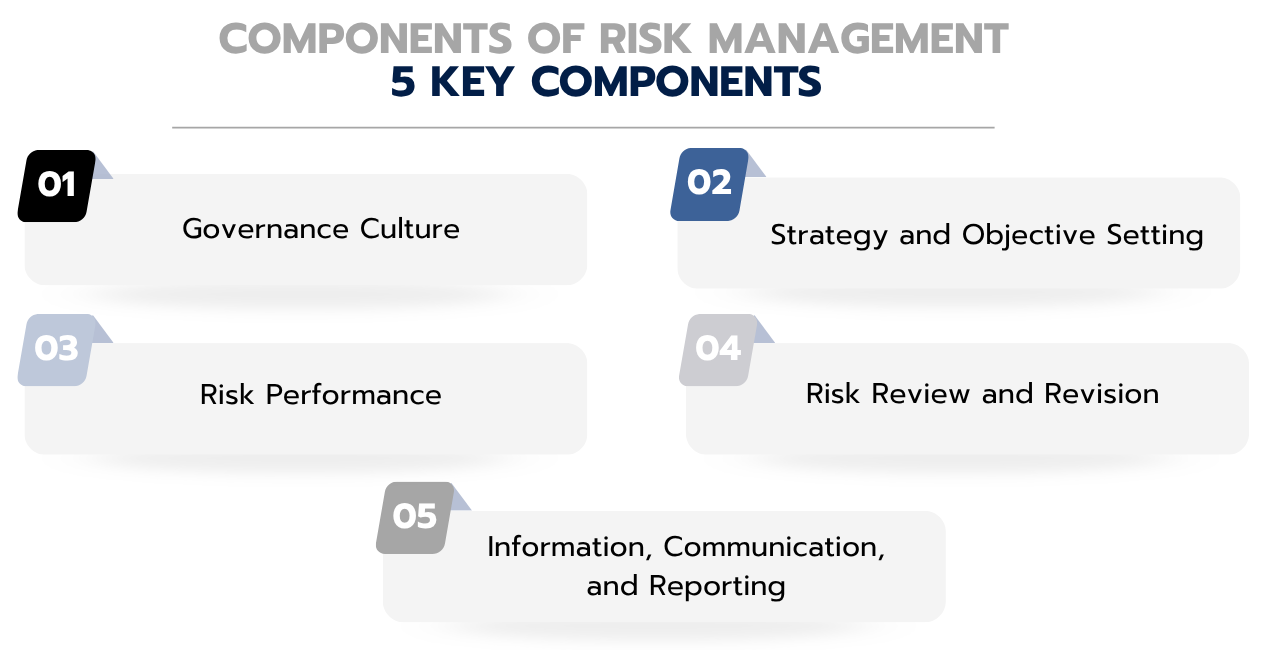
1. Governance Culture
(1) Exercise Board Oversight: defining the roles, responsibilities, structure, and integrated policies covering good corporate governance, risk management, and internal control — collectively referred to as GRC (Governance, Risk Management, and Compliance) — and ensuring that these are disseminated, reviewed, updated, and implemented by relevant staff and departments, including the establishment of principles for defining Risk Appetite (RA).
(2) Establishes Operating Structure: clearly defining the organisational structure and responsibilities of those accountable for risk management and internal control, with defined job functions and supporting work plans.
(3) Defines Desired Culture: establishing an environment and culture that supports risk management and internal control, including providing knowledge and training to relevant management, staff, and Risk Owners, to foster awareness and understanding of risk management within the organisation.
(4) Demonstrate Commitments to Core Values: developing and embedding behaviours that cultivate a risk culture aligned with and supportive of the Company's core values.
(5) Attracts, Develops, and Retains Capable Individuals: establishing plans to clearly link risk management performance assessments with remuneration and incentives at each level of management, cascading organisational-level indicators to functional levels — particularly risk management indicators covering both departmental risk factors and activities that support risk management — through the development of Risk Profiles for each unit, and integrating these with Human Capital management processes.
2. Strategy and Objective Setting
(1) Analyze Business Context: strategic planning and the alignment of the risk management process and risk management strategies with the organisation's policies, strategic objectives, strategies, project plans, and investment plans.
(2) Define Risk Appetite: defining the organisation's risk appetite as either a target level (single value) or a range, and establishing Risk Tolerance (RT) parameters — demonstrating alignment and consistency with the organisation's Business Objectives, and supporting Value Creation and Value Enhancement through risk management to ensure responsiveness to the organisation's strategic objectives.
(3) Evaluate Alternative Strategy: conducting assessments covering strategic planning and the sub-components of Strategic Formulation.
(4) Formulate Business Objectives: establishing strategic objectives to enhance organisational value, identifying business opportunities, and analysing the risk factors associated with such opportunities — incorporating these into the risk management process through analysis of both internal and external environments, with the aim of reducing the severity of risks facing the organisation.
3. Risk Performance
(1) Identify Risk: identifying organisational-level risks in alignment with the risk categories defined by the organisation, taking into consideration internal and external factors, strategies, organisational direction and operations, weaknesses, stakeholder needs, and Inherent Risks — to define the organisation's complete Risk Universe, assess the effectiveness and adequacy of controls, and determine Residual Risks, while communicating identified risk factors to relevant responsible parties.
(2) Defining Control Activities: establishing and developing control activities through a process of assessing the adequacy of the internal control system, ensuring that all departments conduct evaluations of control activities as part of functional-level risk factor analysis, integrating digital technology development into the design of control activities, and reviewing control activities during the year — as part of the risk management plan to control risks across all organisational activities.
(3) Assesses Severity of Risk: assessing the severity of each risk factor in terms of both likelihood and impact, using historical data or future projections, to determine the severity level of each factor. Severity levels (likelihood and impact) must be set in relation to the organisation's Risk Boundary, to enable clear risk classification and severity targets for all risk factors. Assessment criteria are communicated to relevant responsible parties, and digital technology systems are applied to develop severity measurement criteria and produce quarterly reports for each risk factor.
(4) Prioritize Risk: defining the organisation's risk tolerance boundaries relative to goals and strategic objectives, including the organisation's overall risk appetite, through the preparation of risk maps and quarterly reporting.
(5) Implements Risk Response: determining risk mitigation approaches, including processes and criteria for evaluating the Cost-Benefit of each risk management option across all Residual Risks that have been prioritised at the organisational level; establishing criteria for the review of risk management plans and control activities; defining Risk Correlation Map analysis and related processes; and designing Work Systems and Work Processes for organisational operations.
(6) Develops Portfolio View: establishing a process for examining the interrelationships and impacts of risks across different units within the organisation, or defining an integrated organisational risk analysis — identifying the causes and severity of risks from all factors and analysing the relationships between such factors and causes in collaboration with Risk Owners; and defining a Portfolio View of Risk analysis by examining Risk Tolerance ranges for each risk factor and at the organisational level, and communicating and building understanding with Risk Owners.
4. Risk Review and Revision
(1) Reviews Risk and Performance: establishing a regular process for reviewing and improving risk management outcomes in response to changing environments and emerging circumstances, or where outcomes do not meet defined targets — through monitoring performance against activities in the risk management plan, risk severity targets, and defined risk appetite levels, and reporting organisational performance to enable analysis of new risk issues arising from significant changes.
(2) Pursue Improvement in ERM: establishing procedures for improving the organisation's risk management process, including reviewing and defining improvement approaches in alignment with changes to plans, the organisation's strategic objectives, vision, key performance indicators, and performance monitoring processes.
(3) Assesses Substantial Change: conducting assessments covering strategic planning, monitoring and review of action plan implementation, and plan adjustments — to enable analysis of issues that may arise from significant changes, and to support regular review and improvement of risk management practices as necessary.
5. Information, Communication, and Reporting
(1) Communicate Risk Information: defining processes and channels for communicating enterprise risk management, and surveying levels of staff awareness, consciousness, and attitudes towards risk management and internal control — building understanding to ensure that risk management and internal control awareness covers all staff groups, departments, Risk Owners, and management, and meets defined targets. The review and improvement of communication channels should be linked to personnel development and digital technology development processes.
(2) Reports on Risks, Culture and Performance: establishing a process for reporting risk management outcomes against the Mitigation Plan and Existing Controls, submitting internal control evaluation reports in accordance with internal control practice guidelines — including corrective measures — and linking risk management reporting processes to the development of the organisation's information and digital systems, and Early Warning System (EWS).
(3) Leverage Information Technology: establishing a process for developing digital technology systems that support the risk management process, and developing an Early Warning System (EWS) linked to organisational objectives — encompassing data collection, reporting, and severity and EWS analysis — alongside Business Continuity Management (BCM) processes, ensuring that timely information is communicated to relevant departments to enable effective use of systems in support of good risk management.
Risk Management Approach
The Company recognises the importance and necessity of adopting an internationally standardised risk management system, with the aspiration of becoming an organisation that delivers customer satisfaction, maintains a strong corporate image, and develops its operations in a consistent and aligned manner throughout the organisation. The Company's risk management approach is defined as follows.
1. The Company places importance on managing risks across all areas under a systematic internal control framework, by defining risk factors through a two-dimensional risk assessment — evaluating both the Likelihood of an event occurring and the Impact severity of such an event. The Company also defines its Risk Appetite and establishes Warning Signs — events or risk levels that trigger action by responsible personnel to ensure that risk levels do not exceed defined risk ceilings.
2. Respond to organisational risks through prevention or mitigation measures, to reduce both the likelihood of events occurring and the severity of their impacts.
3. Assign designated personnel to regularly monitor, assess, and review risk management outcomes, and report to the Executive Committee and Audit Committee on a quarterly basis.
4. Define risk management as the responsibility of personnel at all levels, who are required to be aware of risks and actively participate in preventing risks that may arise from operations within their own departments and across the organisation. Risk assessments must cover at minimum the following areas:
(a) Financial and liquidity risks
(b) Operational risks
(c) Business strategy risks
(d) Regulatory compliance risks
(e) Marketing risks
(f) Business environment risks
(g) Reputational risks
(h) Technology change risks
(i) Sustainability risks
(j) Emerging risks
5. The Executive Committee and Audit Committee shall promote and develop the adoption of modern information technology systems in the risk management process and in the organisation of the Company's risk management reporting, to ensure that risk management is conducted efficiently.
6. The Company shall support personnel at all levels in having comprehensive access to risk management information.
In addition, the Company will conduct regular reviews of the Risk Management Policy to ensure its continued relevance to the Company's operating conditions and business characteristics. In 2025, this Risk Management Policy was reviewed and approved at the Board of Directors' Meeting No. 5/2025, held on 14 November 2025, and has been in effect from that date onwards.
Policy Document Link
https://www.ir.eurocreations.co.th/storage/corporate-governance/corporate-policies/euro-risk-management-policy-th.pdf
Page Number in Report
1-9
Risks to the Company's Business Operations
Introduction
Investment in the Company's ordinary shares involves risks. Investors should carefully review all information contained in this annual report and exercise sound judgement in considering the risk factors identified in this section, as well as other information appearing in this document, prior to making any investment decision in the Company's ordinary shares.
The risks identified below represent certain material risks that may have an adverse effect on the Company's business, financial position, operating results, business opportunities, and share value. In addition, there may be other risks beyond those identified in this document of which the Company is not aware, or other risks that the Company currently considers unlikely to have a material impact on its future business operations but which may become material risks. Such risks could have a material adverse effect on the Company's business, cash flows, operating results, financial position, liquidity, sources of funding, and business opportunities.
Investors should also consider the information set out in this section in conjunction with the forward-looking statements appearing in this document, which are subject to risks and uncertainties — as indicated by language such as "believes," "anticipates," "expects," "plans to," "intends," "estimates," "is exposed to," "aims," "should," or similar expressions — as well as the cautionary statements relating to forward-looking statements in other parts of this document. Furthermore, financial projections, future projects, forecasts regarding performance, business plans, business expansion plans, changes in laws relevant to the Company's business operations, government policies, and other matters that constitute forward-looking statements represent the Company's current views and do not constitute a guarantee of future performance or events. Accordingly, actual results may differ materially from such projections as a result of certain factors, including the risks described in detail below and in other sections of this document.
With respect to information referencing or relating to the government or the overall economic conditions of the Thai market and other markets globally, the Company has obtained such information from publicly disclosed sources or reproduced it from official government documents or other sources believed to be reliable. However, the Company has not independently verified or certified the accuracy of such information or the methods by which it was obtained.
The Company has assessed the risk factors that are material to its current business operations, classified by nature of risk, in alignment with the nature of its business and changing operating environment. For each risk, the Company has described in detail the nature of the risk, its potential impacts, and the risk management measures in place, as set out below.
Risk Register
| Risk Name | Risk Characteristics | Consequences | Management Measures | Related Risk Factors |
|---|---|---|---|---|
| Risk from reliance on brand owners | The Company generates revenue from sales and services under luxury brands sourced from overseas, with certain brands accounting for a significant proportion of the Company's total revenue. This arises from the Company's appointment as the exclusive distributor in Thailand for such brands. The associated risks may stem from changes in trade policies, contractual terms, product allocation, minimum order quantity requirements, or the termination or non-renewal of distributor agreements, as well as circumstances in which the Company is unable to fully comply with the conditions stipulated in such agreements. | The risk arising from dependence on the brand-owning companies may result in the Company being unable to source sufficient products to meet customer demand, or experiencing delays in product procurement. In addition, brand owners may reserve the right to distribute products directly in accordance with the general trade terms set out in the distributor appointment agreements, and such agreements may also include conditions relating to minimum annual purchase quantities, or requirements for prior consent in the event of a material change in shareholding structure or control of the business. Should the Company fail to comply with the conditions stipulated in the agreements, the distributor agreements may be terminated, which could have a material adverse effect on the Company's business, cash flows, operating results, and financial position. | The Company has entered into agreements with the relevant brand-owning companies in accordance with standard business practices applied by brand owners to their distributors, and conducts its partnerships under a collaborative business partnership framework. For core products, the Company has been appointed as the exclusive distributor in Thailand, and certain brands have been renewed on a continuous basis for periods of up to six years, reflecting the strong and mutually beneficial relationships maintained between the parties. In addition, the Company has demonstrated a consistent ability to generate sales for brand owners, complemented by the strategic advantage of showroom locations situated in high-potential areas and key business districts — leading brand owners to recognise the Company as a capable and valuable business partner for the Thai market. This serves to mitigate the risk of brand dependency over the long term. The Company also implements systematic measures to manage this risk. The brand portfolio is diversified across more than 30 brands spanning three core pillars — Luxury Living & Aesthetic Excellence, Technology & Smart Living, and Wellness & Health — reducing reliance on any single brand or product category. The Company maintains close and regular communication with brand owners through participation in international trade fairs, product training programmes, and joint marketing initiatives, which serves to strengthen relationships and deepen mutual understanding of business directions. Furthermore, the Company continuously monitors and evaluates its compliance with contractual obligations — including annual purchase targets and brand standards — to ensure full and timely adherence to all requirements, thereby reducing the risk of distributor agreement termination or non-renewal. | 735 · Description: Reliance on large partners / distributors or few partners / distributors · Info category: STRATEGIC_RISK |
| The risk of economic fluctuations and relying on the real estate sector. | The Company serves both retail customers (B2C) and business customers (B2B), with revenue in the past year split at approximately 63:37 respectively. The Company's B2C customers are High Net Worth Individuals (HNWIs), who generally maintain stable purchasing power and are not affected by economic conditions to the same degree as general consumers. Nevertheless, consumer confidence within this group may be impacted by macroeconomic uncertainty or financial market volatility during certain periods. With regard to the business customer segment (B2B), which comprises luxury real estate developers, hotels, office buildings, and fitness clubs, revenue from this segment is directly linked to the real estate development cycle. Should there be a slowdown in new project launches, delays in construction schedules, or a reduction in investment in premium residential, hotel, and office projects, revenue from B2B customers may decline or experience delays in recognition, which could have an adverse effect on the Company's operating results. | Should the economy experience growth, with increased liquidity in the economic system and expansion in the real estate sector — across luxury residential, hotel, and premium office segments — high net worth individuals are likely to increase their demand for premium living products and solutions, while property developers are also expected to invest more in luxury furnishings and living solutions for their projects. However, should the domestic economy experience a slowdown or recession, or encounter volatility arising from domestic or international environmental factors, spending confidence among high net worth individuals may decline, and property developers may delay or reduce investment in premium real estate projects. This could have a material adverse effect on the Company's business, cash flows, operating results, and financial position. | In light of the uncertain economic environment and reliance on the real estate sector as described above, the Company recognises the risks that may arise and has established the following risk management measures. The Company focuses on curating products targeted at high-purchasing-power customers who make purchasing decisions based on brand value and quality rather than price, resulting in demand for the Company's products being more resilient to economic volatility than general consumer goods. In addition, the Company continuously pursues a brand portfolio expansion strategy spanning all three core pillars — Luxury Living & Aesthetic Excellence, Technology & Smart Living, and Wellness & Health — to diversify risk and reduce dependence on any single product category or customer segment. In terms of revenue management, the Company maintains a balanced revenue mix between B2C and B2B customer segments, enabling retail customer revenue to provide support during periods when project-based revenue slows in line with the real estate cycle, and vice versa. The Company also closely monitors economic trends and real estate development patterns to inform its product curation strategy, showroom development, and marketing channel development, while continuously studying consumer behaviour to ensure that strategies can be adjusted in a timely manner. Furthermore, the development of the Euro Creations / Thonglor 3 (T3) project and the Ecosystem Clustering Strategy in the Thonglor district will strengthen the Company's capability to present comprehensive products and solutions to both customer segments, and enhance the Company's long-term competitiveness. | 728 · Description: Volatility in the industry in which the company operates · Info category: STRATEGIC_RISK |
| AI and Cybersecurity risk | The widespread adoption of digital technology, information systems, and Artificial Intelligence (AI) in business operations, together with the collection and processing of customer and business data in digital systems, may expose the Company to cybersecurity risks — such as cyberattacks, unauthorised access to data, personal data breaches, information technology system disruptions, or the inappropriate use of AI technology. In addition, the Company relies on third-party vendor systems — in particular SAP B1 and Salesforce — as core operational platforms. Should such systems experience disruption or become unavailable, this could directly impact the Company's sales processes, customer service delivery, and organisational data management. | Should the Company experience a cybersecurity incident or information technology system disruption, this may result in the loss or leakage of sensitive customer and business data, which could materially affect the confidence of HNWIs customers and the Company's brand image. Furthermore, the Company may face legal risks arising from non-compliance with the Personal Data Protection Act (PDPA), and such incidents could adversely affect the Company's operating results and financial position. | The Company has implemented systematic measures to manage technology-related risks, including the establishment of cybersecurity controls across all organisational information systems — encompassing Role-based Access Control and regular system reviews — alongside the implementation and enforcement of a personal data protection policy in compliance with the Personal Data Protection Act (PDPA), to ensure that the collection and processing of customer data is conducted in accordance with applicable laws. In addition, the Company has established guidelines for the responsible and transparent use of AI technology, and has developed a Disaster Recovery Plan (DRP) to enable swift restoration of operations in the event of system disruption. The Company also continuously develops cybersecurity awareness and knowledge among personnel at all levels, with the aim of reducing the risk of unintentional actions that could lead to system security incidents. | 744 · Description: Information security and cyber-attack · Info category: OPERATIONAL_RISK · 737 · Other name: Emerging Risk · Description: Other · Info category: STRATEGIC_RISK · 1720 · Description: System disruption risk · Info category: OPERATIONAL_RISK |
| The risk of inventory management. | The Company primarily imports products from overseas, with purchasing arrangements comprising both advance orders to support future sales and orders placed to meet specific customer requirements. The majority of products are large in size and high in value, with relatively long production and shipping lead times from the country of origin. In general, the period from the date of order placement to the date of arrival in Thailand is approximately five to six months, or potentially longer. Products are imported predominantly by sea, requiring careful advance planning and inventory management. During this period, imported products may be recorded as inventory and held in warehouses awaiting sale, or awaiting delivery to customers who have already placed orders but are unable to take delivery due to the delivery destination — such as a residential property, hotel, or office building — being under construction or not yet ready for use. This results in the Company carrying elevated inventory levels and extended stock turnover periods. In addition, the Company may face the risk of inventory write-downs should market demand shift, selling prices decline, products deteriorate or become obsolete, or the average Inventory Days exceed expectations. | Should the Company be unable to manage its inventory effectively, storage costs and warehouse space expenses may increase, given that the majority of products are large in size and high in value. Elevated inventory levels and extended Inventory Days may therefore impact the Company's ability to accommodate new stock, as well as its liquidity and cash flows. In addition, the Company may be required to recognise the allowance for decrease in value of inventories and obsolescence at levels higher than anticipated, all of which could have a material adverse effect on the Company's operating results, financial position, and cash flows. | The Company carefully plans its purchasing and inventory management by drawing on historical sales data, market demand trends, the expertise and experience of its team, and supporting information from brand owners — to analyse and forecast order quantities in alignment with customer demand. In addition, the Company has developed an inventory management system integrated with SAP B1, enabling real-time monitoring of inventory levels, stock turnover periods, and the age of products across each product category. The Company also manages warehouse storage space and the distribution of products to showrooms appropriately, and has established an inventory write-down allowance policy based on product type, age, and condition — with inventories stated at the lower of cost or net realisable value. In cases where customers are unable to take delivery of products as scheduled, the Company has a storage agreement policy for goods that have been paid in full but are pending delivery, and has prepared additional warehouse space to accommodate such storage requirements. This serves to mitigate cash flow risk and enhance flexibility in the Company's inventory management. | 1721 · Description: Inventory risk · Info category: OPERATIONAL_RISK |
| The risk of not being able to expand showrooms within the designated timeframe, incurring costs higher than budgeted, or the investment plan for showroom expansion not going as expected. | The expansion of the Company's showrooms requires significant capital investment and effective project management. Risks may arise from construction delays, design modifications, cost overruns, or business assumptions that differ from actual conditions — resulting in showroom expansion projects failing to be completed within the defined timeframe or incurring costs in excess of the budgeted amounts. The Company aims to curate and present a diverse range of products to meet customer needs across every stage of furnishing residential properties, condominiums, hotels, office buildings, and sports clubs. Showroom expansion is therefore critical to accommodating new products and brands both now and in the future. Should the showroom investment plan fail to proceed as anticipated, or should returns on investment fall below targets, the Company may be unable to expand its product portfolio and accommodate new brands as planned — which could affect its long-term revenue growth potential. As at 31 December 2025, the Company has one showroom currently under construction and fit-out, namely Euro Creations / Thonglor 3 (T3), which is expected to commence operations in 2026. Should the project not proceed according to plan, this may impact the Company's distribution channel expansion plans and its capacity to increase retail floor space. | Should showroom expansion proceed according to the Company's plans, it is expected to support sales generation and deliver the marketing benefits the Company aims to achieve. However, the Company may face the risk of being unable to complete showroom expansions within the defined timeframe, due to delays in design, construction, or related processes, as well as the risk of construction costs exceeding the budgeted amounts. Furthermore, the showroom investment plan may not proceed as anticipated should the business assumptions used in planning — such as projected sales, cost of goods and services, capital investment, and showroom operating expenses — differ from actual conditions, which could have a material adverse effect on the Company's business, cash flows, operating results, and financial position. | The Company carefully studies the feasibility of each showroom expansion, taking into consideration relevant factors such as location, product type, target customer segment, projected sales, construction costs, and operating expenses, and prepares project plans and selects contractors through a competitive tendering and negotiation process to ensure the best outcomes for the Company. The Company submits budgets and investment plans to management for review and approval prior to commencing any project, and regularly monitors progress and manages costs — reporting to management to support plan reviews, cost control, and operational adjustments in response to changing circumstances — to ensure that investments remain within budget and on schedule, and to mitigate the risk of delays or actual costs exceeding estimates. In addition, the Company regularly reviews the business assumptions and financial projections used in investment planning to ensure their continued relevance in light of changing conditions, and is prepared to adjust investment plans or reprioritise projects in a timely manner should actual circumstances differ materially from expectations. | 746 · Description: Delays in the development of future projects · Info category: OPERATIONAL_RISK |
| The risk of relying on key management and skilled employees. | The Company operates as a comprehensive Luxury Lifestyle and Wellness Living Solutions provider, requiring personnel with relevant experience, knowledge, and specialist expertise — across brand sourcing and negotiation, the development and maintenance of relationships with brand owners, and the formulation of marketing strategies and business development. The Company therefore faces the risk of dependence on key management and highly capable and experienced personnel. Key management plays a critical role in business operations and development, as well as in maintaining strong relationships with business partners and brand owners. Should the Company be unable to retain key management or capable personnel, or be unable to recruit suitably qualified replacements in a timely manner, this could impact the continuity of business operations, the maintenance of brand owner relationships, and the Company's long-term competitiveness. | Should the Company be unable to recruit or replace personnel of equivalent or comparable calibre in a timely manner, this could have a material adverse effect on the Company's business operations, management continuity, operating results, and financial position. | The Company recognises the risk of dependence on key management and capable personnel, and has accordingly developed a Succession Plan for senior management, stipulating that candidates for such positions must possess the vision, experience, and expertise consistent with the nature of the Company's business operations and strategy. In addition, the Company maintains a continuous personnel development policy to promote the development of knowledge, capabilities, and skills appropriate to each role and responsibility, in alignment with the Career Path of personnel at each level — with the aim of ensuring management continuity and reducing the risk of dependence on any single individual. The Company also places importance on retaining capable personnel by establishing competitive remuneration and benefits policies in line with industry standards, in order to foster motivation and long-term employee engagement with the organisation. | 738 · Description: Reliance on employees in key positions · Info category: OPERATIONAL_RISK |
| The risk of project work being delivered later than scheduled and penalties according to the contract terms for project delays. | The Company sells products and provides installation services to both retail and business customers, covering a range of product types including System Furniture such as kitchen systems and wardrobe systems, lighting, building automation and control systems, and flooring materials. The proportion of revenue derived from business customers has shown a consistent upward trend, accounting for approximately 32%, 33%, and 37% of total revenue for the financial years ended 31 December 2023, 2024, and 2025 respectively. The nature of supply-and-install work typically involves contractual delivery milestones at each stage of completion, with penalties stipulated in the event that work cannot be delivered within the defined timeframe. Risks may arise from a number of factors, including delays in the delivery of products and equipment from suppliers, changes to installation specifications during the course of works, or the inability to control operations in accordance with the defined plan. Furthermore, for projects that are under construction, the Company may be required to await the handover of the premises from the project owner, or the rectification of works by other contractors or service providers, prior to commencing installation. Such factors are beyond the Company's control and may result in the inability to commence or proceed with installation as planned, giving rise to the risk of delayed delivery beyond the timeframes stipulated in the agreements. | Should the Company be unable to control such factors and deliver work within the timeframes stipulated in the agreements, the Company may incur increased costs — such as inventory storage costs — and in cases where delays are attributable to the Company, it may be required to bear contractual penalties (where applicable). Furthermore, delayed delivery in luxury projects may adversely affect the Company's image and long-term relationships with customers and property developers. Such factors could have a material adverse effect on the Company's operating results, cash flows, and financial position. | The Company has established rigorous operational procedures and appointed site supervisors to oversee, monitor, and evaluate the progress of each phase of work, as well as to coordinate between business partners and customers, ensuring that operations proceed in accordance with the project plan and contractual conditions. In addition, the Company plans its product orders in advance and closely monitors delivery status from suppliers, to ensure that products and equipment are ready for installation in accordance with the defined schedule. The agreements clearly define the scope of the Company's responsibilities and liability limits, to mitigate risks that may arise in the future. The agreements also stipulate that in the event of delays not attributable to the Company, the delivery period shall be extended accordingly, without constituting a breach of contract or giving rise to penalty liability. Furthermore, should an extension of time be required due to any other factors, the Company will promptly contact and negotiate with the customer to notify them of the circumstances and request an extension. In cases where the customer delivers the premises to the Company late, the Company shall be entitled to a corresponding extension of the delivery period in accordance with the conditions stipulated in the agreement. | 746 · Description: Delays in the development of future projects · Info category: OPERATIONAL_RISK |
| Fraud and Corruption Risk | The Company may face risks of fraud and corruption in its business processes, particularly in activities relating to procurement, business contracting, and dealings with suppliers, contractors, government agencies, or other stakeholders. Such risks may include the offering or receiving of improper benefits, bribery, undue facilitation, or the dishonest exercise of authority. These risks may arise from the actions of employees, management, business partners, or other persons associated with the Company at any level. | Should an incident of fraud or corruption occur, it may have a material impact on the Company across several dimensions, as follows.
| The Company places great importance on the prevention of and protection against fraud and corruption, and has established the following key measures and practices. Policy and Governance Framework: The Company has established a clear Anti-Bribery and Corruption Policy covering all employees, management, and persons associated with the Company. The policy has been published on the Company's website to ensure transparent and accessible communication to all stakeholders. Training and Awareness: The Company provides regular training on business ethics and anti-corruption practices for employees and management, with the aim of building knowledge and understanding, and instilling an organisational culture of integrity and transparency at all levels of the organisation. Whistleblowing Channels: The Company has established channels for receiving complaints or whistleblowing reports relating to fraud, ethical misconduct, or violations of the Company's policies, through multiple channels including email, telephone, and a Whistle Blow Box located at the reception area of the head office. The Company is committed to providing appropriate protection for complainants and whistleblowers, and to maintaining strict confidentiality of all information received. Monitoring and Investigation: Complaints or concerns received are subject to a review, examination, and investigation process in accordance with the Company's defined procedures, with reporting to the Board of Directors or relevant committees as appropriate, to ensure that all actions are taken fairly, transparently, and in a manner that is subject to scrutiny. Building Organisational Culture and Continuous Improvement: The Company is committed to fostering an organisational culture grounded in integrity, transparency, and business ethics, while continuously developing and strengthening its anti-fraud and anti-corruption systems to align with international best practices. Future Objectives: The Company aims to further strengthen its anti-fraud and anti-corruption systems in preparation for membership of the Thai Private Sector Collective Action Against Corruption (CAC) within the next five years. | 758 · Description: Violations of laws and regulations · Info category: COMPLIANCE_RISK · 736 · Description: Damage to company image and reputation · Info category: STRATEGIC_RISK · 754 · Description: Corruption · Info category: OPERATIONAL_RISK |
| The risk from fluctuations in foreign exchange rates. | The Company imports the majority of its products and services from overseas, with payments made primarily in foreign currencies — namely the Euro and the US Dollar. For the financial years ended 31 December 2023, 2024, and 2025, the Company's purchases of products and services from both domestic and overseas sources included foreign currency payments accounting for approximately 92%, 90%, and 88% of total purchase orders respectively. The movement of exchange rates is subject to a number of factors — including inflation rates, interest rates, current account balances, levels of public debt, and domestic and international economic conditions — which the Company is unable to control or forecast with precision. Should the Thai Baht appreciate, import costs would be reduced; conversely, should the Thai Baht depreciate, import costs may increase. In cases where the Company is unable to adjust its selling prices in a timely manner, this could have an adverse impact on the Company's profit margins. | Should foreign exchange rates move in a direction unfavourable to the Company, this could have a material adverse effect on the Company's business, cash flows, operating results, and financial position. | The Company recognises the risk of foreign exchange rate volatility that may impact the cost of product procurement, and has established risk control measures by monitoring trends and factors affecting exchange rate movements, in order to assess the situation and determine appropriate hedging strategies. Should exchange rates experience volatility with a likely impact on product costs, the Company will monitor the situation closely and consider adjusting selling prices to accommodate any resulting impact as appropriate. In addition, the Company considers the use of financial hedging instruments — such as forward foreign exchange contracts or currency insurance — taking into account various factors including the ratio of import costs to profit, opportunity costs, the costs of hedging instruments, and the risk level of each currency, to ensure that risk management is conducted appropriately and delivers the greatest benefit to the Company. In the period from 2023 to 2025, the Company was not materially impacted by foreign exchange rate volatility. For the financial years ended 31 December 2023, 2024, and 2025, the Company recorded net foreign exchange gains of Baht 5.16 million, Baht 6.48 million, and Baht 2.27 million respectively, reflecting the effectiveness of the Company's foreign exchange risk management measures. | 764 · Description: Fluctuation in exchange rates, interest rates, or the inflation rate · Info category: FINANCIAL_RISK |
| The risk from interest rate volatility. | The Company utilises partial funding from financial institution borrowings, with such loans structured on a floating interest rate basis — exposing the Company to the risk of rising interest rates in financial markets arising from changes in monetary policy or economic conditions. As at 31 December 2025, the Company had outstanding long-term borrowings of Baht 1.00 million and no outstanding short-term borrowings | Should floating interest rates trend upwards significantly, the Company may incur higher interest expenses, which could have a material adverse effect on the Company's business, cash flows, operating results, and financial position. | The Company regularly monitors changes in interest rates, and carefully plans its debt structure and borrowing strategies to align with market conditions and the Company's financial position. In addition, the Company maintains strong relationships with its partner commercial banks, enabling it to negotiate appropriate interest rates and financial terms, in order to mitigate the impact of interest rate volatility and maintain financial liquidity effectively. | 764 · Description: Fluctuation in exchange rates, interest rates, or the inflation rate · Info category: FINANCIAL_RISK |
| The risk related to financing and liquidity and the risks associated with compliance and terms in loan agreements. | The Company requires capital for working capital purposes and business expansion. Should the Company be unable to secure sufficient or appropriate funding, or should financial market conditions shift in an unfavourable direction, borrowing costs may increase or the Company may be unable to renew its credit facilities as planned, which could have an adverse effect on the Company's business opportunities and growth. The Company has entered into, and may from time to time enter into, loan agreements with financial institutions. As at 31 December 2025, the Company has outstanding long-term borrowings with financial institutions, subject to contractual terms and conditions — including requirements relating to major shareholders, the maintenance of defined financial ratios, restrictions on material changes to the nature of business operations, and the prohibition of any actions that may adversely affect the Company's ability to fulfil its obligations under the loan agreements. In addition, the loan agreements require the Company to notify the relevant financial institutions of any changes to non-public information that may affect the Company's management, policies, regulations, or accounting principles — such as changes in key management or changes in financial transaction approval authority. Should the Company be unable to comply with such terms and conditions, this may give rise to liquidity risk or a breach of the loan agreements. | Should the Company be unable to secure funding or manage its liquidity, or fail to comply with the terms and conditions of its loan agreements, this could have a material adverse effect on the Company's business, cash flows, operating results, and financial position. | The Company regularly monitors compliance with the terms and conditions of its loan agreements, maintains a consistent record of on-time debt repayment, and closely plans and monitors its financial structure to ensure full and continuous compliance with all financial obligations and loan agreement conditions. In addition, the Company maintains strong relationships with its partner financial institutions and communicates relevant information to them transparently and in a timely manner, in order to build confidence and sustain the Company's financial liquidity over the long term. | 761 · Description: Insufficient sources of funding · Info category: FINANCIAL_RISK · 1724 · Description: Liquidity risk · Info category: FINANCIAL_RISK |
| Climate Variability Risk | The Company imports almost all of its furniture and lifestyle products from overseas, with the majority of shipments transported by ocean freight — a mode of transport that is sensitive to weather volatility, particularly severe weather events such as typhoons, strong winds, or adverse sea conditions, which may prevent vessels from docking on schedule or cause delays in the transportation and unloading process. In addition, weather variability and the intensifying global trend of Climate Change may give rise to flooding, inundation, or other natural events domestically, which could disrupt transportation, product distribution, and the timely delivery of goods to customers. Furthermore, severe natural events may directly impact the Company's premises and warehouses, which are used to store high-value products. Should damage to inventory or disruption to operations occur, this could affect the Company's ability to serve customers and fulfil contractual delivery obligations. | Should climate volatility risks materialise, they may impact the Company's business operations across several dimensions, as follows. Impact on Revenue and Costs: Delays in product imports may result in the Company being unable to deliver products to customers as planned, affecting sales plans, installation schedules, and after-sales service. The Company may also incur additional costs, including Demurrage & Detention charges, increased freight costs arising from weather disruptions, and additional logistics management expenses, and certain revenue may not be recognisable within the planned period. Impact on Customer Confidence and Corporate Reputation: Delayed product delivery may affect customer satisfaction, brand confidence, and the Company's image — particularly among luxury customers who place great importance on service quality and timely delivery. Such factors could have a material adverse effect on the Company's business, cash flows, operating results, and financial position. | The Company recognises the significance of climate volatility risks and has established appropriate risk management measures, as follows. Logistics Planning and Risk Diversification: The Company closely monitors weather conditions and shipping developments in collaboration with freight carriers and Freight Forwarders, to adjust transportation plans accordingly and reduce the risk of over-reliance on any single route or time period. Appropriate Inventory Management: The Company plans buffer inventory levels for products critical to business operations, to accommodate potential delays arising from uncertain weather conditions and mitigate the impact on product delivery to customers. Protection of Assets and Inventory: The Company arranges marine cargo insurance and property insurance to mitigate financial losses that may arise from natural events affecting the Company's inventory and premises. Transparent and Timely Customer Communication: In the event of delays, the Company places great importance on communicating information to customers clearly, transparently, and in a timely manner, in order to foster understanding, maintain confidence, and preserve long-term customer relationships. | 1717 · Description: ESG risk · Info category: STRATEGIC_RISK · 1719 · Description: Climate change and disasters · Info category: STRATEGIC_RISK |
Risks to Securities Holders' Investment
Introduction
Investors should consider the risks that may affect their investment in the Company's securities, arising from the Company's shareholding structure, management policies, and financial position. The material risks may be summarised as follows.
Risk Register
| Risk Name | Risk Characteristics | Consequences | Management Measures | Related Risk Factors |
|---|---|---|---|---|
| The risk of having major shareholders with influence over management policy decisions. | The Company was founded by the Gambir family, who as at 31 December 2025 collectively hold approximately 59.54% of the Company's total issued and paid-up shares. Members of the Gambir family have expressed their intention to hold shares and act jointly (Acting in Concert), resulting in the Gambir family having significant influence over the determination of the Company's policies and management direction, as well as voting at general meetings of shareholders on significant matters such as the appointment of directors and resolutions requiring a majority vote of the shareholders' meeting. This is subject to cases where applicable laws or the Company's articles of association require a vote of not less than three-quarters of the total votes of shareholders attending and entitled to vote, as well as cases where the Gambir family has an interest in the vote. | As the Gambir family holds approximately 59.54% of the Company's total issued and paid-up shares, other shareholders may not be able to accumulate sufficient votes to scrutinise or counterbalance decisions proposed by the Gambir family. This may result in significant decisions of the Company being made in a manner that does not align with the expectations or interests of all other shareholders, and could affect investor confidence over the long term. | The Company has clearly defined the scope of authority, duties, and responsibilities of each board committee — comprising the Board of Directors, the Audit Committee, the Nomination and Remuneration Committee, and the Executive Committee — to ensure an effective, transparent, and accountable corporate governance mechanism. The Board of Directors comprises a total of 8 members, of whom 3 are independent directors, representing more than one-third of the total number of directors. All 3 independent directors serve as members of the Audit Committee, in order to independently oversee and review the Company's operations. In addition, the Company has established guidelines governing related party transactions, or transactions involving directors, major shareholders, controlling persons, or persons who may have a conflict of interest, as well as a conflict of interest prevention policy — requiring that interested parties are not entitled to vote on relevant agenda items, so that business decisions are made in the best interests of the Company and its shareholders as a whole. | 768 · Description: Return from investment of securities holder · Info category: HOLDER_RISK · 2969 · Description: Risk of the company having a majority shareholder holding > 50% of shares · Info category: HOLDER_RISK |
| The risk related to the company's ability to pay dividends. | The Company's dividend payments shall be determined by reference to operating results, cash flows, financial position, capital requirements for operations and investment, compliance with the Memorandum of Association, the Company's Articles of Association, applicable laws and regulations, and such other factors as the Board of Directors considers appropriate. The Company's ability to pay dividends in the future may not be consistent with historical dividend payments, and is subject to the discretion of the Board of Directors and shareholder resolutions. The Company may be unable to pay dividends should the Board of Directors resolve to withhold dividend payment, or should shareholders not approve the distribution. In addition, dividend payments may be restricted by the terms and conditions of future credit facility agreements, or by expenses and liabilities that may reduce the cash available for distribution. Pursuant to the Public Limited Companies Act and the Company's Articles of Association, the Company may not pay dividends if there are accumulated losses, even if the Company records a net profit in that year. The Company may only distribute dividends when there are no accumulated losses and the Company has recorded a net accounting profit for the year. | Should the Company be unable to pay dividends, or pay dividends at a rate below expectations, shareholders may not receive a return on their investment in the form of dividends, which could affect investor confidence and the Company's share price in the capital market. | The Company has a dividend payment policy of not less than 30% of net profit from the separate financial statements after corporate income tax and statutory reserves. The Company will comprehensively assess its operating results, cash flows, financial position, and capital requirements, while complying with applicable laws and regulations and taking into account other internal and external factors, in order to allocate capital efficiently and deliver the greatest long-term benefit to all stakeholders. The Company regularly monitors and reports on its financial position to maintain an appropriate balance between liquidity management, business expansion, and the delivery of suitable returns to shareholders. | 768 · Description: Return from investment of securities holder · Info category: HOLDER_RISK |