

Sustainability · 2025
In this section49 topics
- Sustainability Policy & Goals — Overview1 item
- Sustainability Policy2 items
- Sustainability Goals & UN SDGs3 items
- Policy Review3 items
- Business Value Chain1 item
- Stakeholder Analysis2 items
- Environmental Policy & Guidelines3 items
- Environmental Policy Review2 items
- Energy — Plan & Guidelines2 items
- Energy — Electricity Consumption1 item
- Energy — Fuel Consumption1 item
- Energy — Targets3 items
- Energy — Performance & Outcomes2 items
- Water — Plan & Guidelines2 items
- Water — Withdrawal, Discharge & Consumption1 item
- Water — Targets3 items
- Water — Performance & Outcomes2 items
- Waste — Plan & Guidelines2 items
- Waste — Generation, Disposal & Recycling1 item
- Waste — Targets3 items
- Waste — Performance & Outcomes2 items
- GHG — Plan & Guidelines2 items
- GHG — Emissions1 item
- GHG — Emissions Verification1 item
- GHG — Principles & Standards1 item
- GHG — Targets2 items
- GHG — Performance & Outcomes2 items
- Environmental Legal Incidents1 item
- Social Policy & Guidelines4 items
- Social Policy Review2 items
- Social — Principles & Standards Practised1 item
- Human Rights Due Diligence1 item
- Employees — Plan & Guidelines3 items
- Employees — Workforce1 item
- Employees — Remuneration & Provident Fund1 item
- Employees — Training & Development1 item
- Employees — Occupational Health & Safety1 item
- Employees — Labour Relations1 item
- Employees — Employee Representation1 item
- Employees — Targets3 items
- Employees — Performance & Outcomes2 items
- Customers — Plan & Guidelines3 items
- Customers — Satisfaction Results1 item
- Customers — Targets3 items
- Customers — Performance & Outcomes2 items
- Community & Social — Plan & Guidelines3 items
- Community & Social — Targets3 items
- Community & Social — Performance & Outcomes2 items
- Law Violation Incidents1 item
Sustainability Policy & Goals — Overview
Introduction
Sustainability Reporting for the Year 2025
Euro Creations Public Company Limited ("the Company") has prepared this sustainability report for the 12-month period from 1 January to 31 December 2025, to communicate progress in driving sustainable business practices by considering impacts and value creation across three key dimensions: governance, social, and environmental — focusing on matters that are material to the Company's business operations, competitiveness, and long-term growth.
In preparing this sustainability report for 2025, the Company has referenced the United Nations Sustainable Development Goals (SDGs) and the SET Sustainability Reporting Guide, to ensure that disclosures are comprehensive, transparent, and consistent with relevant standards.
Reporting Scope
Governance, social, and environmental data covers the activities and performance of the Company's core business operations.
Report Preparation and Data Verification Process
The Company has assigned the Sustainable Development Working Group, in collaboration with the Company Secretary, to collect, verify, and control the quality of data used in preparing this report, to ensure that all information is accurate, complete, and in accordance with the defined framework and guidelines. Responsible departments report their approaches, procedures, and progress in driving sustainability initiatives to the Executive Committee, Audit Committee, and Board of Directors respectively.
Contact Information
Company Secretary, Euro Creations Public Company Limited
Tel: 02-744-9624
Sustainable Development Working Group Structure
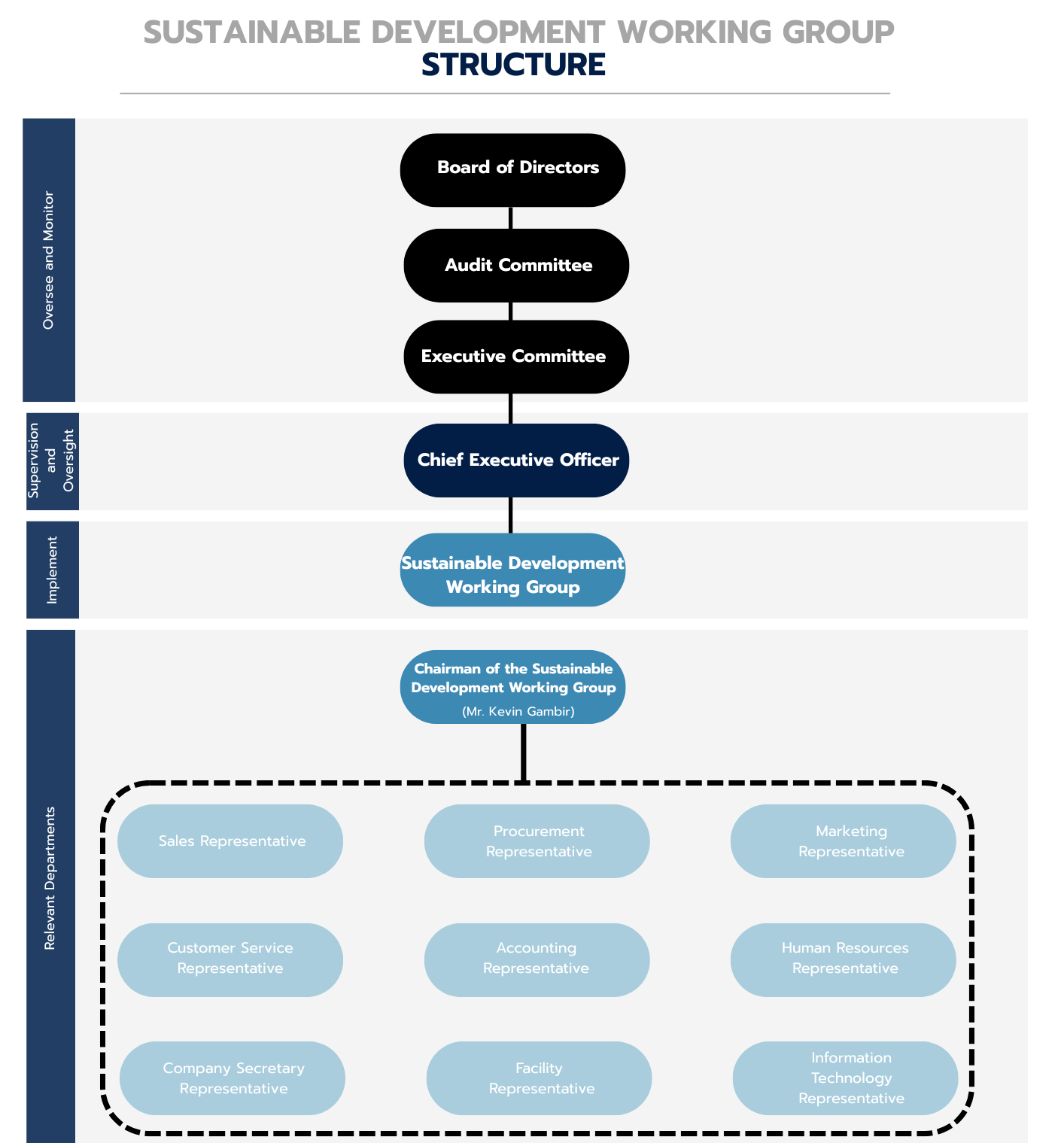
The Board of Directors plays a key role in overseeing the organisation's sustainability direction, by considering the policy framework, objectives, and sustainability approaches, and periodically monitoring progress — to ensure that the Company's business operations are aligned with good corporate governance principles, risk management, and the creation of long-term value for stakeholders.
The Company places importance on integrating sustainability concepts into its corporate governance and organisational management, with clearly defined roles and responsibilities for driving sustainability at every level of the governance structure. The Board of Directors and Audit Committee are responsible for overseeing and reviewing strategic direction, the operational framework, and material sustainability issues and objectives, while the Executive Committee is responsible for translating such strategies and policies into practice and continuously monitoring progress, to ensure that sustainability efforts deliver tangible outcomes.
The management and Sustainable Development Working Group report operational results and progress of sustainability activities to the Board of Directors through the Executive Committee and Audit Committee respectively, enabling the Board to monitor, evaluate, and provide guidance on the Company's sustainability direction as appropriate.
The Company has established a Sustainable Development Working Group comprising Mr. Kevin Gambir (Director and Chief Executive Officer) as Chairman of the Sustainable Development Working Group, and representatives from relevant departments — responsible for coordinating, planning, and driving sustainability operations at the operational level, and supporting governance of strategies, policies, and practices covering governance, social, and environmental (ESG) matters, to ensure that operations are aligned and consistent with the Company's defined objectives.
Sustainability Policy
Has a Sustainability Policy
Yes
Policy Description
The Company conducts its business under the concept of balanced and sustainable growth, integrating environmental, social, and governance (ESG) considerations into its strategy and operations at every level of the organisation, with the aim of creating long-term value for all stakeholder groups and supporting the United Nations Sustainable Development Goals (SDGs).
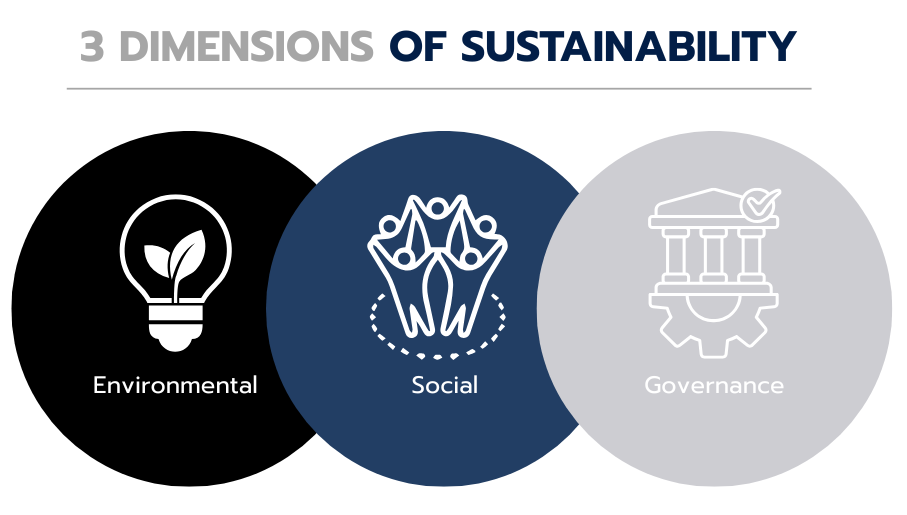
The Company has established a written sustainability policy to serve as a framework for conducting business and systematically managing ESG issues, covering three key areas as follows.
1. Environmental
The Company places importance on managing the environmental impact of its business operations throughout the value chain, focusing on reducing unnecessary resource consumption, improving energy and water use efficiency, and promoting systematic waste and refuse management. The Company supports operational practices that help mitigate long-term environmental impact and are responsive to climate change.
2. Social
The Company is committed to creating a business environment that respects human dignity and diversity, placing importance on human rights, equality, and employee safety, as well as developing the capabilities of its people in preparation for future business changes. The Company also promotes strong relationships with business partners, customers, and communities, supporting participation and social development in ways that are consistent with the organisation's context and areas of operation.
3. Governance
The Company conducts its business under a clear, transparent, and accountable corporate governance structure, adhering strictly to ethical principles, accountability, and compliance with applicable laws and regulations. The Board of Directors and management place importance on risk management, internal controls, and decision-making based on information and the best interests of the Company and its stakeholders, in order to strengthen organisational confidence and long-term sustainability.
Sustainability Goals & UN SDGs
Has Sustainability Goals
Yes
Goals Description
In 2025, the Board of Directors' Meeting No. 4/2025 considered and approved the Company's sustainability issues and targets, both short-term and long-term, to serve as a framework for defining operational direction and integrating sustainability concepts into the Company's strategy and business operations. The key sustainability management targets are as follows.
1. Good Corporate Governance
The Company places importance on conducting business in accordance with good corporate governance principles, with a focus on strengthening a management structure that is transparent, accountable, and responsible to all stakeholder groups, in support of prudent strategic decision-making and stable long-term growth.
2. Anti-Fraud and Anti-Corruption
The Company is committed to conducting business with integrity and adherence to business ethics, by establishing clear measures and practices for the prevention of and protection against fraud and corruption, while promoting an organisational culture grounded in transparency and strict compliance with applicable laws and regulations.
3. Community Development and Corporate Social Responsibility
The Company recognises its role as part of society, and places importance on participation in and support for community development in the areas where it operates — creating shared value through social activities consistent with community contexts, and promoting quality of life and the sustainable growth of society as a whole.
4. Employee Development and Quality of Life
The Company values its employees as the organisation's key resource, and is committed to continuously developing their knowledge, skills, and capabilities, alongside caring for their quality of life, safety, and appropriate working environment — to foster engagement and readiness for future business changes.
5. Sustainable Supply Chain Management and Responsible Procurement
The Company is committed to promoting sustainable supply chain management, with targets for key suppliers to comply with the Company's defined sustainability guidelines, and by conducting regular ESG screening, evaluation, and monitoring of suppliers — to ensure that the Company's supply chain operates responsibly and in alignment with sustainability principles.
6. Product and Service Quality and Safety
The Company is committed to curating products and services of quality and standard, by selecting internationally certified brands, inspecting product quality prior to delivery, and providing installation services by qualified specialists. The Company also provides after-sales service and product warranty systems to build lasting customer confidence and satisfaction.
7. Customer Relationship Management
The Company places importance on building and maintaining strong long-term customer relationships, with a focus on developing communication, service delivery, and responsiveness to customer feedback — to drive the development of products and services that meet customer needs and strengthen confidence in the Company's brand.
8. Environmental Management and Sustainable Resource Use
The Company aims to reduce the environmental impact of its business operations by focusing on efficient resource use and the management of energy, fuel, water, waste, and refuse, while supporting operational practices that promote environmental conservation and long-term sustainable growth.
9. Greenhouse Gas Emission Reduction
The Company recognises the importance of climate change and is committed to systematically managing related risks and opportunities, with targets to monitor and disclose greenhouse gas emissions data in accordance with international standards — to serve as a baseline for defining emissions reduction strategies and supporting long-term sustainable growth objectives.
UN Sustainable Development Goals
| SDG Goal |
|---|
| Goal 1 No Poverty |
| Goal 3 Good Health and Well-being |
| Goal 4 Quality Education |
| Goal 6 Clean Water and Sanitation |
| Goal 7 Affordable and Clean Energy |
| Goal 8 Decent Work and Economic Growth |
| Goal 11 Sustainable Cities and Communities |
| Goal 12 Responsible Consumption and Production |
| Goal 13 Climate Action |
| Goal 16 Peace, Justice and Strong Institutions |
Policy Review
Policy Reviewed This Year
Yes
Policy Changed This Year
Yes
Review Details
During the past year, the Board of Directors' Meeting No. 4/2025 considered and approved the Company's sustainability issues and targets, and provided recommendations for improving the targets across each issue to be more comprehensive, clear, and appropriate to the current business context and changing business environment — covering governance, social, and environmental dimensions.
Such improvements are focused on ensuring that sustainability targets are linked to corporate strategy, risk management, and long-term value creation, and can be translated into concrete action and monitored and evaluated appropriately. The Company will use the reviewed sustainability issues and targets as a framework for driving sustainability plans and activities in the next phase.
Business Value Chain
Value Chain Description
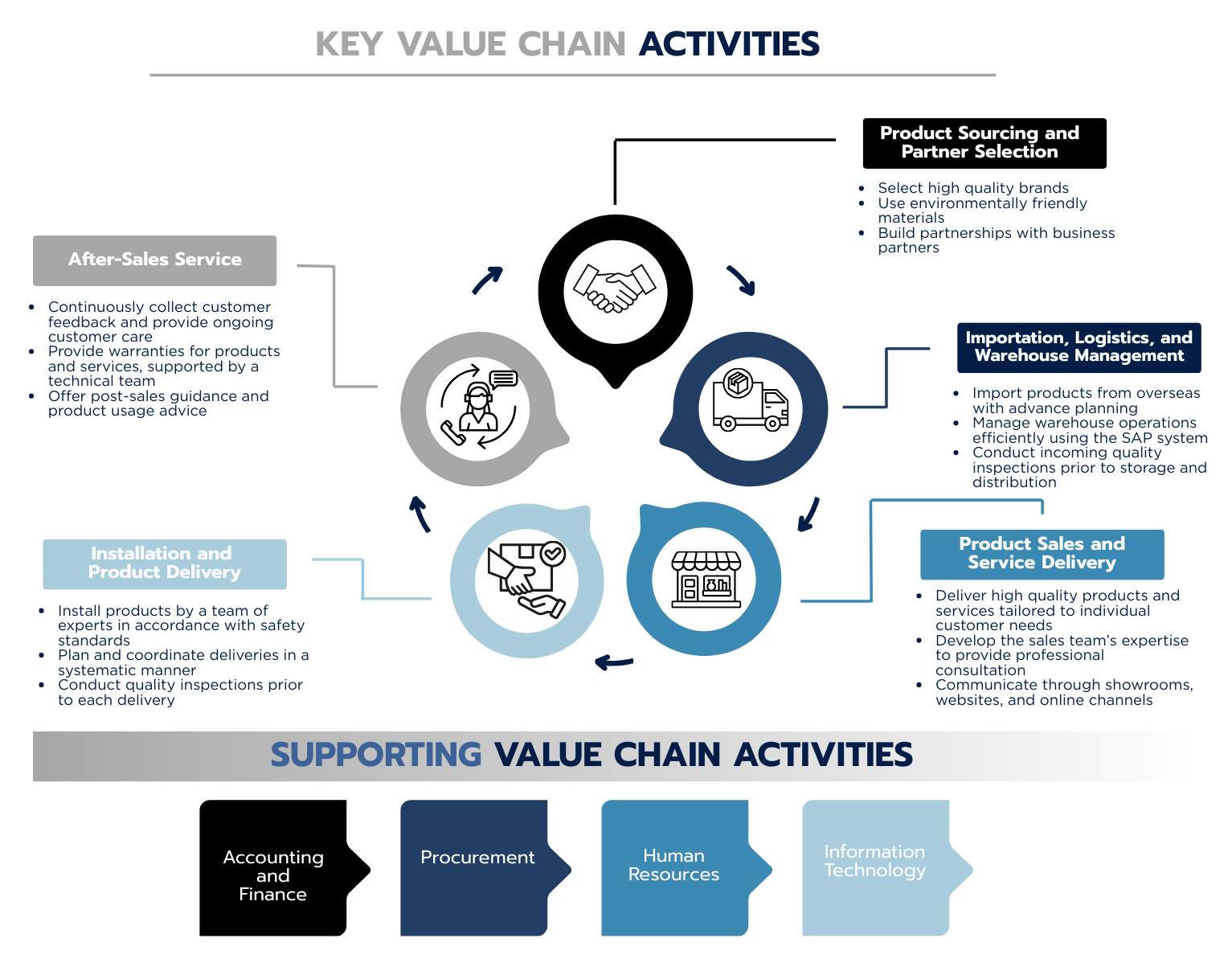
The Company conducts its business across a value chain spanning upstream, midstream, and downstream activities, placing importance on stakeholder management and the consideration of governance, social, and environmental impacts at every stage of operations, in support of long-term sustainable business growth. The Company's value chain can be divided into three main segments as follows.
Upstream
1. Product Sourcing and Partner Selection
The Company selects brands and products from manufacturers that maintain high quality standards and conduct business responsibly, taking into consideration environmental, social, and legal standards. The Company places importance on the use of materials and production processes that are environmentally friendly and minimise ecological impact — such as formaldehyde-free materials, the use of water-based wood stains that are free from natural solvents, and the promotion of reforestation initiatives.
The Company is committed to building long-term Strategic Partnerships with business partners on the basis of transparency and mutual benefit, and has established a Supplier Code of Conduct to promote ethical business conduct throughout the supply chain.
2. Importation, Logistics, and Warehouse Management
The Company imports products from overseas manufacturers, primarily European brands, through ocean freight as the main mode of transportation. This requires advance procurement planning, as the lead time from order placement to delivery in Thailand is generally approximately five to six months.
The Company manages its logistics and warehouse operations efficiently to support quality and on-time product delivery, with a focus on cost control, safety, and product quality at every stage. The Company has implemented SAP B1 across the product receiving, storage, and transfer processes to improve accuracy and enable systematic data tracking.
In addition, the Company conducts incoming quality inspections on all imported products prior to storage and distribution, and prepares appropriate storage areas by product type. The Company also strives to reduce the environmental impact of its logistics operations through efficient resource use — including systematic packaging and waste management.
Midstream
3. Product Sales and Service Delivery
The Company places importance on creating a positive customer experience throughout the sales and service process, for both retail customers (B2C) and business customers (B2B). The focus is on presenting products and services of quality that are appropriate for use and meet the specific needs of each customer. The Company also continuously develops the capabilities of its sales team to ensure comprehensive product knowledge and the ability to provide accurate and professional consultancy to customers, alongside conducting sales promotion, advertising, and public relations activities in an appropriate and transparent manner, to build confidence and long-term customer relationships.
In terms of distribution channels, the Company operates showrooms in Bangkok and the provinces to increase customer accessibility and elevate the product selection experience. The Company communicates the features of its products and services through showrooms, its website, and online media, to reach its target audience comprehensively and appropriately reflect the brand image and value the Company aims to deliver to its customers.
Downstream
4. Installation and Product Delivery
The Company places importance on installation and product delivery that meets defined standards, is of high quality, and is completed within the agreed timeframe, through systematic planning and coordination. Installation is carried out by a team of knowledgeable and skilled specialists, with due attention to occupational safety standards. Following installation, the Company conducts a quality and completeness inspection prior to every handover, to ensure customer confidence and satisfaction.
5. After-Sales Service
The Company places importance on customer satisfaction by providing channels for receiving feedback and complaints, which are used to improve service quality. The Company also provides product quality warranties and/or service guarantees in accordance with defined conditions, supported by a maintenance team and technical specialists who provide timely customer assistance.
In addition, the Company provides product usage guidance and training to customers to ensure correct usage, reduce the likelihood of issues arising, and strengthen confidence in the Company's products and services.
Stakeholder Analysis
Introduction
Stakeholder Analysis
| Stakeholder Type | Stakeholders | Stakeholder Expectations | Response to Expectations | Communication Activities |
|---|---|---|---|---|
| External stakeholders | 2913 · Description: Shareholders · 2936 · Other name: Investors · Description: Others | • Deliver strong, stable, and sustainable business performance with continuous growth.
• Maintain good corporate governance practices.
• Implement effective risk management.
• Ensure transparency in business operations.
• Provide dividend payments to shareholders.
• Generate appropriate returns for shareholders within acceptable risk levels.
• Treat shareholders equally and fairly to protect their interests. | • Maintain good corporate governance practices by conducting business with transparency and fairness while taking into account the interests of shareholders and other stakeholders.
• Establish clear business strategies and manage the organization prudently to support sustainable growth.
• Implement comprehensive and effective enterprise risk management.
• Perform duties with honesty, integrity, and transparency while considering the best interests of the organization and stakeholders as a whole.
• Perform duties professionally with knowledge, expertise, dedication, and due care in managing the organization.
• Disclose information and report the Company’s performance accurately, completely, and transparently.
• Refrain from seeking personal benefits or providing advantages to related persons through the use of undisclosed inside information of the Company.
• Arrange shareholder meetings and provide dividend payments in an appropriate and consistent manner.
• Treat investors and shareholders equally and fairly to protect shareholders’ interests. | 2938 · Description: Visit · 2941 · Description: Online Communication · 2944 · Description: Annual General Meeting (AGM) · 2945 · Description: Complaint Reception |
| Internal stakeholders | 2921 · Description: Employees | • Fair and equitable treatment of all employees, with respect for human rights, human dignity, and non-discrimination.
• Appropriate determination of compensation, benefits, and salary adjustments in line with performance and economic conditions, in order to enhance employees’ and their families’ quality of life.
• Continuous development of employees’ capabilities through training, learning opportunities, and skill development relevant to their roles.
• Ensuring occupational health, safety, and an appropriate working environment to reduce the risk of workplace accidents and work-related illnesses.
• Providing employees with opportunities for career advancement and development to prepare them for higher responsibilities.
• Providing channels for employees to participate in expressing opinions or offering suggestions for organizational improvement.
• Care for employees' physical and mental health, and promoting overall well-being both within and outside the workplace. | • Provide fair and appropriate compensation and benefits in line with employees’ knowledge, capabilities, responsibilities, and performance, with regular consideration of salary adjustments.
• Promote employee capability development through training, knowledge sharing, and the enhancement of skills necessary for job performance, in order to maintain work quality in line with industry standards.
• Ensure that employee appointments, transfers, rewards, and disciplinary actions are conducted transparently and fairly, based on employees’ knowledge, capabilities, and performance.
• Treat all employees equally and without discrimination, while respecting human rights and refraining from discrimination based on race, gender, age, religion, or any other status unrelated to job performance.
• Maintain a safe working environment that protects the life, health, and property of employees, while promoting occupational health and safety practices.
• Provide employees with appropriate opportunities for career advancement and support their development to prepare them for higher responsibilities.
• Encourage employees at all levels to participate in expressing opinions, providing suggestions for work improvement, and contributing to problem-solving within their departments and across the organization.
• Promote awareness and adherence to the Company’s code of conduct and employees’ roles and responsibilities.
• Strictly comply with labor laws and all relevant regulations.
• Promote employees' physical and mental health through activities and welfare programmes that support quality of life and well-being in and outside the workplace. | 2941 · Description: Online Communication · 2942 · Description: Internal Meeting · 2945 · Description: Complaint Reception · 2946 · Description: Employee Engagement Survey · 2948 · Description: Training / Seminar |
| External stakeholders | 2923 · Description: Customers | • Products and services that are of high quality, meet recognized standards, and effectively respond to customers’ needs.
• Products and services that demonstrate responsibility toward society and the environment.
• Strict compliance with terms and agreements with customers.
• Efficient and prompt customer service, with appropriate support and assistance.
• Availability of reliable after-sales services to ensure customer satisfaction.
• Maintaining long-term relationships with customers while safeguarding the confidentiality of customer information.
• Protection of customers' personal data in accordance with applicable laws and relevant standards. | • Select and provide products and services of high quality while maintaining consistent quality standards at all times.
• Disclose information about products and services accurately, completely, and without distortion of facts.
• Provide product and service warranties under appropriate terms and periods, including compensation where applicable in accordance with the nature of each product or service.
• Refrain from delivering products or services to customers when it is known that such products or services are defective or damaged.
• Utilize systems and technologies to enhance customer service and enable prompt responses to customer inquiries or feedback.
• Maintain the confidentiality of customer information and refrain from using such information for personal or improper benefit.
• Strictly comply with terms and conditions agreed with customers. In cases where the Company is unable to comply, customers will be notified in advance in order to jointly seek appropriate solutions.
• Listen to customer feedback and suggestions to continuously improve and develop products and services.
• Establish and enforce a personal data protection policy in compliance with the Personal Data Protection Act (PDPA), to ensure that customer data is collected and processed accurately and securely. | 2938 · Description: Visit · 2941 · Description: Online Communication · 2945 · Description: Complaint Reception · 2947 · Description: Satisfaction Survey |
| External stakeholders | 2899 · Description: Suppliers | • Maintain a cooperative business relationship.
• Ensure fairness and equality in all processes and terms of collaboration.
• Support one another to achieve sustainable mutual growth.
• Operate with the best interests of both the Company and its partners in mind.
• Conduct business on the basis of sustainability, with consideration of environmental and social impacts throughout the supply chain. | • Conduct business with honesty, ethics, and straightforwardness.
• Select partners based on product quality, advanced IT capabilities, and effective after-sales or service delivery, ensuring excellent customer service. Partners must uphold sound business ethics, engage in fair commercial practices, and promote fair competition.
• Adhere to all conditions agreed upon with partners and creditors. If compliance is not possible, promptly notify them in advance to jointly find solutions and prevent any damage.
• Do not solicit, accept, or offer any improper benefits in dealings with partners, debtors, or creditors.
• Report financial information accurately and completely in line with actual circumstances.
• Incorporate sustainability criteria into the partner selection and evaluation process, and encourage suppliers to comply with ESG guidelines aligned with the Company's direction. | 2941 · Description: Online Communication · 2945 · Description: Complaint Reception |
| External stakeholders | 2902 · Description: Community · 2928 · Description: Society | • Demonstrate responsibility toward local communities and the environment
• Avoid causing adverse impacts on communities
• Listen to community feedback through various channels | • Support activities that serve the public interest.
• Continuously foster a sense of social and environmental responsibility within the organization and among employees at all levels, ensuring no actions are taken that could harm natural resources or the environment.
• Do not endorse any activities that are harmful to society or morality and/or that promote vice.
• Cooperate with and strictly comply with the intent of relevant laws and regulations.
• Conduct business prudently, avoiding any form of negative impact on local communities or the environment.
• Provide channels for community feedback, remaining open to making improvements when deficiencies are identified. | 2940 · Description: Social Event · 2945 · Description: Complaint Reception |
| External stakeholders | 2894 · Description: Creditor · 2925 · Description: Financial institution | • Ability to repay debts in accordance with agreed terms and within defined timeframes.
• Stable financial position with sufficient cash flows.
• Accurate, complete, and transparent disclosure of financial information.
• Transparent and accountable organisational management under good corporate governance principles. | • Manage liquidity prudently to ensure timely debt repayment in accordance with agreed schedules.
• Prepare financial statements and financial reports in accordance with relevant standards, audited by a certified public accountant.
• Disclose financial information and material data transparently to support the decision-making of creditors and financial institutions.
• Maintain transparent and accountable organisational management under good corporate governance principles. | 2938 · Description: Visit · 2941 · Description: Online Communication · 2943 · Description: External Meeting |
| External stakeholders | 2931 · Description: Government agencies and Regulators | • Strictly comply with all applicable laws and regulations.
• Cooperate with and support activities and projects of government agencies and regulatory bodies.
• Conduct activities in accordance with good corporate governance principles.
• Disclose ESG information and conduct business sustainably in accordance with the guidelines prescribed by regulatory bodies.
| • Oversee and ensure strict compliance with all applicable laws and regulations.
• Monitor changes in laws and relevant requirements.
• Review and update the Company's policies and procedures to ensure alignment with applicable laws.
• Conduct activities in accordance with good corporate governance principles.
• Disclose ESG information in accordance with the guidelines and standards prescribed by the Stock Exchange of Thailand (SET) and relevant regulatory bodies, in a complete, accurate, and transparent manner.
| 2941 · Description: Online Communication · 2943 · Description: External Meeting · 2945 · Description: Complaint Reception |
Environmental Policy & Guidelines
Has an Environmental Policy
Yes
Policy Description
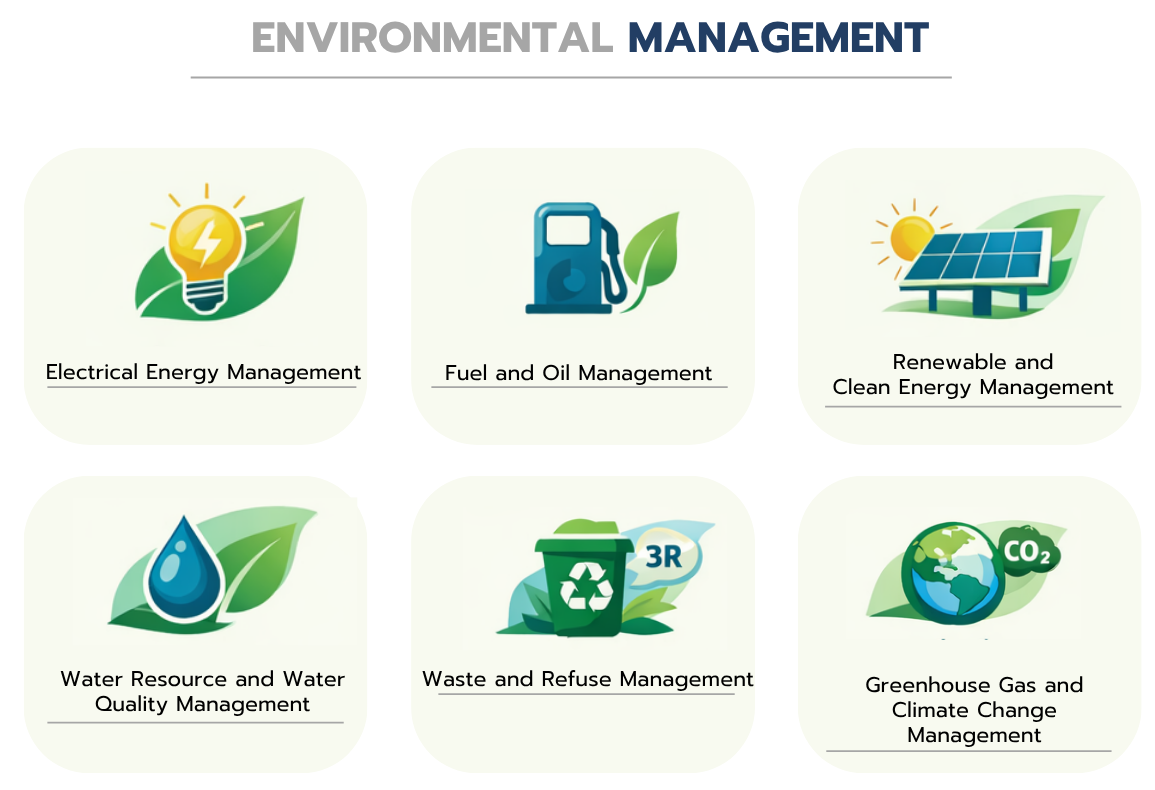
The Company recognises the importance of conducting business with consideration for environmental impacts, and is committed to integrating environmental management into its corporate governance and operations in a systematic manner, by establishing appropriate policies and practices covering key issues as follows.
Electrical Energy Management
The Company is committed to efficient energy use by reducing unnecessary energy consumption and promoting the adoption of energy-saving technologies across all processes, while raising employee awareness and encouraging participation in energy conservation — such as switching off lights and electrical equipment when not in use. The Company also continuously reviews and improves its energy use processes to ensure efficient and sustainable use of energy resources.
Fuel and Oil Management
The Company recognises the importance of efficient fuel use to reduce environmental impact and control operating costs, and has established a policy promoting cost-effective use of fuel and oil with an emphasis on safety and environmental responsibility. The focus is on providing oversight and educating employees on proper operational practices.
Renewable and Clean Energy Management
The Company supports the use of renewable and clean energy to reduce reliance on non-renewable energy sources and lower greenhouse gas (GHG) emissions. The Company procures and installs renewable energy systems in suitable locations, and continuously monitors the performance of renewable energy use to maximise efficiency and contribute to long-term environmental conservation.
Water Resource and Water Quality Management
The Company places importance on the sustainable use of water resources by promoting water conservation and overseeing the efficient use of water across organisational activities. The Company also disseminates knowledge and raises employee awareness of the importance of water, to encourage everyone to use water resources responsibly and to be prepared for potential water scarcity challenges in the future.
Waste and Refuse Management
The Company is committed to reducing the volume of waste and refuse generated from its operations in accordance with the Reduce, Reuse, Recycle (3R) approach, alongside proper waste disposal in compliance with environmental standards. The Company encourages employees to use reusable or recyclable materials and promotes efforts to reduce unnecessary resource consumption — such as transitioning to electronic documents to reduce paper use and maximising the reuse of packaging — while raising employee awareness and emphasising proper waste segregation to facilitate efficient recycling or disposal, thereby reducing both costs and long-term environmental impact.
Greenhouse Gas and Climate Change Management
The Company places importance on reducing greenhouse gas emissions through the use of renewable energy and environmentally friendly technologies, as well as improving internal processes to reduce resource consumption and collaborating with other greenhouse gas reduction initiatives. The Company also encourages employees to participate in climate change mitigation activities and to understand the role of each individual in collectively reducing greenhouse gas emissions, in order to foster ongoing awareness and action.
The Company's environmental policies and practices have been incorporated into and aligned with the organisation's key policy frameworks, including the Good Corporate Governance Policy, the Code of Business Ethics, and the Sustainability Management Policy — to ensure that environmental operations are consistent in direction, clearly defined, and can be translated into concrete action at all levels of the organisation.
In addition, the Company promotes employee participation and awareness of the importance of environmental stewardship through the cultivation of a culture of responsible resource use, in support of reducing environmental impact and strengthening business resilience alongside long-term natural resource conservation. The Company has organised the "Annual Refresher – Corporate Governance Awareness 2025" programme to disseminate and build understanding of the organisation's policies, including environmental policies and practices, communicated through internal channels such as the Company's website, Microsoft Teams, and the HumanSoft system — achieving an awareness rate of 100%.
Environmental Guidelines
| Guideline |
|---|
| Electricity Management |
| Fuel Management |
| Renewable/Clean Energy Management |
| Water Management |
| Waste Management |
| Greenhouse Gas and Climate Change Management |
Environmental Policy Review
Policy Reviewed This Year
Yes
Review Details
The Company reviewed its environmental policies and practices, which fall under the Good Corporate Governance Policy, at the Board of Directors' Meeting No. 5/2025 held on 14 November 2025. The Board was of the view that such policies and practices remain appropriate and consistent with the Company's direction.
Energy — Plan & Guidelines
Has an Energy Management Plan
Yes
Plan Description
The Company has developed an Energy Management Plan to serve as a framework for systematic and efficient management of the organisation's energy consumption, with a focus on reducing unnecessary energy use, improving resource efficiency, controlling operating costs, and minimising the environmental impact of business activities, alongside promoting employee participation in responsible energy use. The Company's Energy Management Plan is defined as follows.
1. Efficient Electrical Energy Management
The Company promotes appropriate use of electrical energy at all premises by encouraging employees to switch on and off lighting, air conditioning systems, and electrical equipment only when necessary, and to switch off equipment immediately when not in use or during breaks. The Company has also upgraded its internal lighting systems by replacing fixtures and bulbs with energy-efficient alternatives, and conducts regular electrical system inspections and maintenance to ensure continuous operational efficiency.
2. Promotion of Renewable and Clean Energy Use
The Company places importance on reducing reliance on fossil fuel energy and has supported the use of renewable energy by installing solar power generation systems (Solar Cells) on showroom rooftops on an ongoing basis, while also exploring the feasibility of expanding renewable energy use to other areas of its premises as appropriate.
3. Communication and Participation in Energy Conservation
The Company regularly communicates and disseminates information on efficient energy use and energy conservation to employees, in order to raise awareness and promote participation in energy reduction efforts. The Company also provides opportunities for employees to propose ideas or suggestions for improving energy use within the organisation, as part of its support for addressing climate change and global warming.
Energy — Electricity Consumption
Electricity Consumption
| Metric | Current Year | Previous Year | Two Years Ago |
|---|---|---|---|
| Total electricity consumption within the organization (Kilowatt-Hours) | 1,625,651.11 | 1,507,338.27 | 1,187,398.3 |
| Electricity purchased for consumption from non-renewable energy sources (Kilowatt-Hours) | 1,425,223.97 | 1,507,338.27 | 1,187,398.3 |
| Electricity purchased or generated for consumption from renewable energy sources (Kilowatt-Hours) | 200,427.14 |
Energy — Fuel Consumption
Fuel Consumption
| Metric | Current Year | Previous Year |
|---|---|---|
| Crude oil (Barrels) | ||
| Coal (Metric tonnes) | ||
| Jet fuel (Litres) | ||
| Diesel (Litres) | 36,593.68 | 37,832.29 |
| Gasoline (Litres) | 4,056.63 | 3,786.16 |
| Fuel oil (Litres) | ||
| Natural gas (Standard cubic feet) | ||
| LPG (Kilograms) | ||
| Steam (Metric tonnes) |
Energy — Targets
Introduction
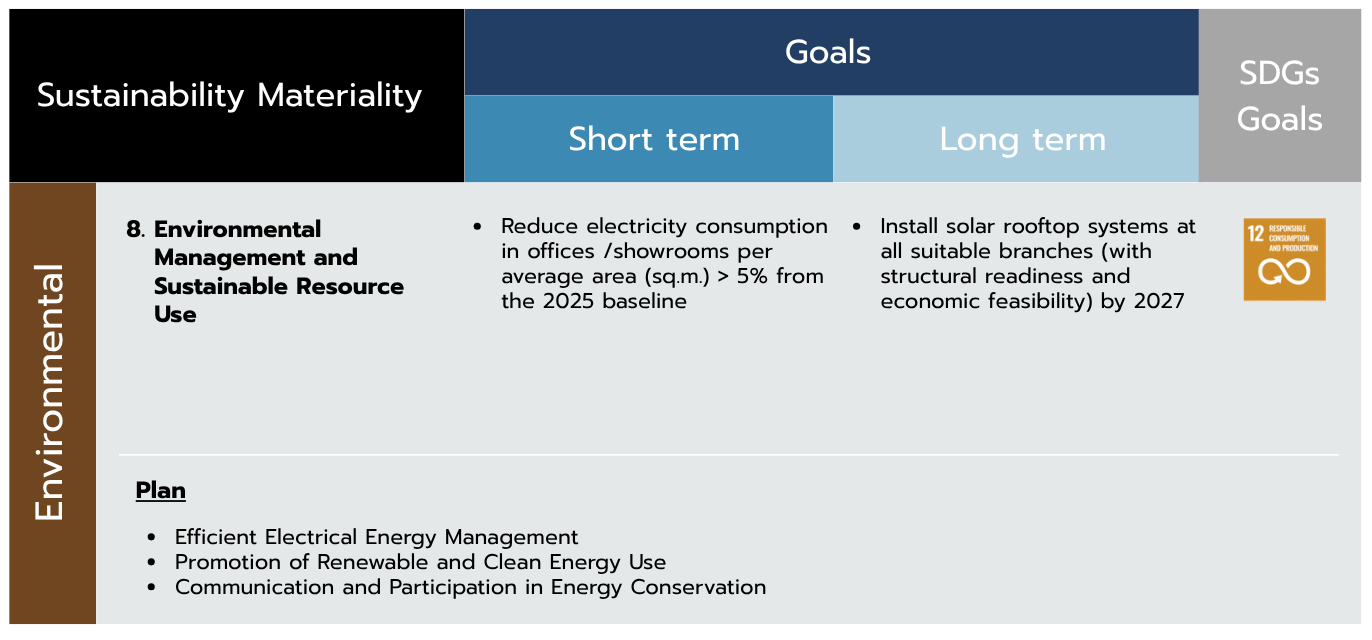
Has Set Targets
Yes
Targets
| Target | Base Year | Target Year | Target Change (%) | Unit | Unit — Please Specify |
|---|---|---|---|---|---|
| Reduction of electricity purchased for consumption | 2,025 | 2,025 | 5 | Others | kilowatt-hour per square meter per year |
Energy — Performance & Outcomes
Has Performance Results
Yes
Performance Description
In the past year, the Company has continuously implemented its Energy Management Plan, focusing on improving energy efficiency, reducing unnecessary energy consumption, and promoting the use of renewable energy, in support of reducing operating costs and minimising the environmental impact of business activities. The details are as follows.
1. Renewable Energy Use from Solar Power Generation Systems (Solar Cells)
As at the end of 2025, the Company has installed solar power generation systems (Solar Cells) at three office and showroom locations, namely
Head Office
Euro Creations Flagship Gallery / Thonglor 7 (T7)
Euro Creations / Thonglor 5 (T5)
The Company has a total solar panel area of 1,091.66 square metres and a total installed capacity of 199.86 kilowatts. In 2025, the Company generated 200,427.14 kilowatt-hours of electricity from its solar panels, resulting in cost savings of Baht 758,312.87 and a reduction in greenhouse gas emissions of 71,737.74 kilograms of carbon dioxide equivalent per year.
Year | Installation Site | Panel Area (sq.m.) | Investment Budget (Baht) | Installed Capacity (kW) | Electricity Generated (kWh) | Cost Savings (Baht/year) | GHG Reduction (kgCO2 eq) |
2024 | - Head Office | 436.41 | 1,567,550.00 | 71.16 | 59,502.01 | 212,898.19 | 14,103.24 |
- Euro Creations Flagship Gallery / Thonglor 7 (T7) | 282.55 | 1,330,732.60 | 49.50 | 52,064.69 | 181,549.57 | 12,340.77 | |
- Euro Creations / Thonglor 5 (T5) | 372.70 | 2,484,465.10 | 79.20 | 15,142.00 | 59,053.80 | 7,964.54 | |
Total | 1,091.66 | 5,382,747.70 | 199.86 | 126,708.70 | 453,501.57 | 34,408.55 | |
2025 | - Head Office | 436.41 | - | 71.16 | 73,327.11 | 274,976.66 | 17,380.17 |
- Euro Creations Flagship Gallery / Thonglor 7 (T7) | 282.55 | - | 49.50 | 47,515.03 | 172,954.70 | 11,262.43 | |
- Euro Creations / Thonglor 5 (T5) | 372.70 | - | 79.20 | 79,585.00 | 310,381.50 | 43,095.14 | |
Total | 1,091.66 | - | 199.86 | 200,427.14 | 758,312.87 | 71,737.74 |
Notes:
Head Office: Solar Cell system operational from April 2024
Euro Creations Flagship Gallery / Thonglor 7 (T7): Solar Cell system operational from January 2024
Euro Creations / Thonglor 5 (T5): Solar Cell system operational from August 2024
2. Improving Electrical Energy Efficiency in Buildings
The Company has implemented measures to improve the use of electrical and air conditioning systems to limit energy consumption during unnecessary periods, including adjusting the operating schedules of air conditioning systems in office areas to align with actual working hours, and promoting appropriate use of electrical equipment. The Company has also progressively replaced electrical equipment with more energy-efficient models, such as LED lighting and energy-label-certified air conditioning units, to reduce overall electricity consumption. In 2025, the Company's purchased electricity consumption at its head office and showrooms was 61.05 kilowatt-hours per square metre of usable floor area, a reduction of 6.8% from the previous year, reflecting improved energy management efficiency.
3. Equipment and Cooling System Maintenance
The Company conducts regular inspections and maintenance of its air conditioning systems and Cooling Towers to ensure efficient system performance, reduce excess energy consumption, extend equipment lifespan, and help reduce greenhouse gas emissions from operations.
4. Energy Management in Transportation Activities
The Company places importance on reducing fuel consumption and greenhouse gas emissions from logistics activities, and has improved its delivery route planning and installation scheduling processes to enable First-time completion, reducing the need for repeat site visits. In 2025, the Company consumed 36,593.68 litres of diesel fuel, a reduction of 3.3% from the previous year, reflecting improved transport route management efficiency.
In addition, the Company strictly adheres to scheduled vehicle maintenance programmes to maintain engine combustion efficiency and reduce fuel consumption, alongside promoting compliance with traffic laws and appropriate driving speeds among drivers — contributing to improved energy efficiency, reduced emissions, and enhanced operational safety.
5. Building Employee Environmental Knowledge and Participation
The Company places importance on raising employee awareness and promoting participation in efficient energy use through internal communications and activities, in order to foster knowledge, understanding, and responsible resource use behaviours in daily work processes. In 2025, the Company organised the "Annual Refresher – Corporate Governance Awareness 2025" programme to communicate and build understanding of environmental policies and practices, including efficient energy use, among employees at all levels — achieving an awareness rate of 100%.
Water — Plan & Guidelines
Has a Water Management Plan
Yes
Plan Description
The Company has developed a Water Management Plan to manage water consumption within the organisation efficiently, reduce unnecessary water use, lower utility costs, and minimise wasteful water loss. Although the Company does not use water in any manufacturing process, water is consumed at its offices, showrooms, and warehouses, necessitating appropriate and responsible management of water resources. The Water Management Plan is defined as follows.
1. Efficient Water Use
The Company encourages employees to use water efficiently and appropriately in daily activities — such as ensuring taps are fully turned off after use, avoiding running water unnecessarily, and using water in quantities appropriate to each activity — in order to reduce the organisation's overall water consumption.
2. Controlling and Reducing Water Loss
The Company conducts regular inspections of plumbing systems, equipment, and water usage points within its buildings, and carries out prompt repairs whenever leaks are identified, in order to reduce water loss and unnecessary costs.
3. Building Employee Awareness and Participation
The Company places importance on building employee knowledge and a sense of responsibility regarding water use, through internal communications and activities, to promote ongoing participation in water resource conservation.
4. Monitoring and Reviewing Water Consumption
The Company monitors water consumption data across each area of its premises and uses such information to review its water management approaches, in order to improve water use efficiency in a manner appropriate to its operations and business environment.
Water — Withdrawal, Discharge & Consumption
Water Withdrawal, Discharge & Consumption
| Metric | Current Year | Previous Year | Two Years Ago |
|---|---|---|---|
| Total water withdrawal (Cubic meters) | 10,163.7 | 10,273.4 | 6,498.9 |
| Total water withdrawal by third-party water (Cubic meters) | 10,163.7 | 10,273.4 | 6,498.9 |
| Total water withdrawal by surface water (Cubic meters) | |||
| Total water withdrawal by groundwater (Cubic meters) | |||
| Total water withdrawal by seawater (Cubic meters) | |||
| Total water withdrawal by produced water (Cubic meters) | |||
| Percentage of wastewater treated before discharge (%) | |||
| Total water discharge (Cubic meters) | |||
| Total water discharge to third-party water (Cubic meters) | |||
| Total water discharge to surface water (Cubic meters) | |||
| Total water discharge to groundwater (Cubic meters) | |||
| Total water discharge to seawater (Cubic meters) | |||
| Total water consumption (Cubic meters) | 10,163.7 | 10,273.4 | 6,498.9 |
| Recycled water (Cubic meters) |
Water — Targets
Introduction
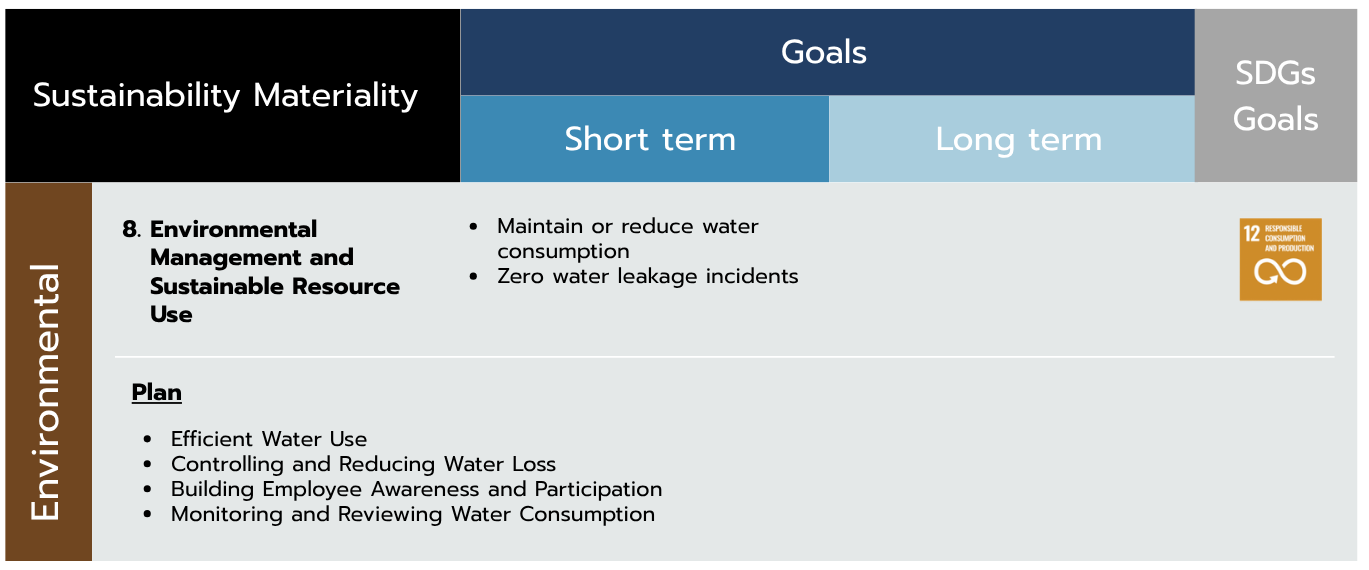
Has Set Targets
Yes
Targets
| Target | Base Year | Target Year | Target Change (%) | Unit |
|---|---|---|---|---|
| Reduction of water withdrawal | 2,025 | 2,025 | 0 | Cubic meters |
Water — Performance & Outcomes
Has Performance Results
Yes
Performance Description
As a result of implementing the Water Management Plan, employees have demonstrated greater awareness and have adopted more responsible water use behaviours, placing importance on appropriate water consumption in daily activities — such as ensuring taps are fully turned off after use and avoiding unnecessary water consumption — resulting in improved water use efficiency across the organisation.
In addition, employees have consistently cooperated in reporting water system issues and leaks, enabling the Company to conduct inspections and carry out repairs in a timely manner, thereby reducing unnecessary water loss and supporting efficient and sustainable water resource management.
In 2025, the Company recorded no water leakage incidents from its internal operations.
Waste — Plan & Guidelines
Has a Waste Management Plan
Yes
Plan Description
The Company has developed a Waste and Refuse Management Plan to manage waste generated from its operations in an appropriate manner, reduce the volume of waste requiring disposal, minimise environmental impact, and promote efficient resource use. The Plan covers waste and refuse generated from offices, showrooms, warehouses, and business support activities, and is summarised as follows.
1. Waste Reduction (Reduce)
The Company aims to reduce waste generation at source by promoting efficient resource use, minimising unnecessary consumables, and selecting packaging or materials that can be reused or recycled.
2. Appropriate Waste Segregation
The Company segregates waste by type — including general waste, recyclable waste, and hazardous waste — to ensure that all waste is managed and disposed of correctly in accordance with applicable laws and standards.
3. Reuse and Recycle
The Company promotes the reuse of materials that remain in usable condition, and supports the transfer of recyclable waste to licensed collectors or recyclers, in order to reduce the volume of waste requiring final disposal.
4. Safe Hazardous Waste Management
The Company collects, controls, and disposes of hazardous waste — such as light bulbs, batteries, and chemically contaminated materials — in accordance with applicable laws and the requirements of relevant authorities, to reduce risks to employees, communities, and the environment.
5. Building Employee Awareness and Participation
The Company places importance on communicating and building employee knowledge and understanding of proper waste segregation and refuse management, in order to promote participation and instil environmentally friendly behaviours in daily life.
6. Monitoring and Reviewing Performance
The Company regularly monitors and reviews its waste and refuse management practices, using the resulting data to evaluate the effectiveness of its measures and improve operational approaches in a manner appropriate to and consistent with business changes.
Waste — Generation, Disposal & Recycling
Waste Generation, Disposal & Recycling
| Metric | Current Year |
|---|---|
| Total waste generated (Kilograms) | 8,866.98 |
| Non-hazardous waste (Kilograms) | 8,866.98 |
| Non-hazardous waste - Landfilling (Kilograms) | |
| Non-hazardous waste - Incineration (with energy recovery) (Kilograms) | |
| Non-hazardous waste - Incineration (without energy recovery) (Kilograms) | |
| Non-hazardous waste - Other disposal operations (Kilograms) | |
| Hazardous waste (Kilograms) | |
| Hazardous waste - Landfilling (Kilograms) | |
| Hazardous waste - Incineration (with energy recovery) (Kilograms) | |
| Hazardous waste - Incineration (without energy recovery) (Kilograms) | |
| Hazardous waste - Other disposal operations (Kilograms) | |
| Total reused/recycled waste (Kilograms) | |
| Reused/Recycled non-hazardous waste (Kilograms) | |
| Reused non-hazardous waste (Kilograms) | |
| Recycled non-hazardous waste (Kilograms) | |
| Reused/Recycled hazardous waste (Kilograms) | |
| Reused hazardous waste (Kilograms) | |
| Recycled hazardous waste (Kilograms) |
Waste — Targets
Introduction
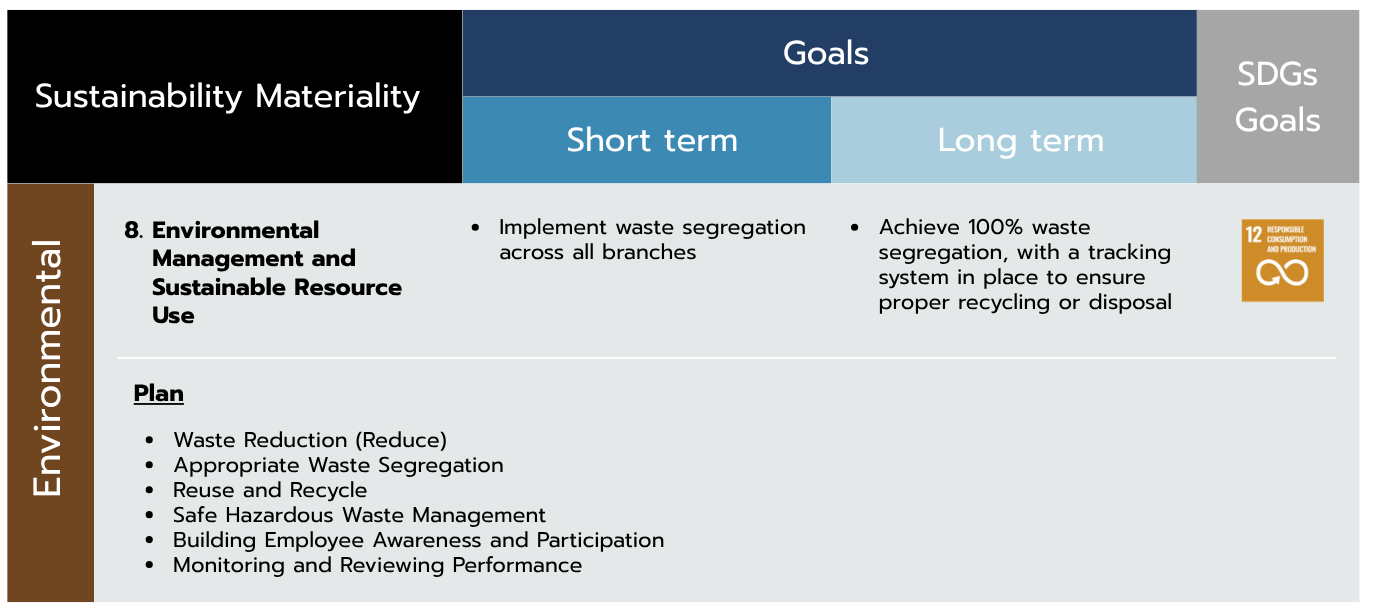
Has Set Targets
Yes
Targets
| Waste Type | Disposal Approach | Target | Target Year | Target Change (%) | Unit |
|---|---|---|---|---|---|
| Non-hazardous waste | 2758 · Description: Reuse · 2759 · Description: Recycle · 2760 · Description: Landfilling · 2761 · Description: Incineration with energy recovery · 2762 · Description: Incineration without energy recovery | Increase waste utilization | 2,030 | 100 | Kilograms |
Waste — Performance & Outcomes
Has Performance Results
Yes
Performance Description
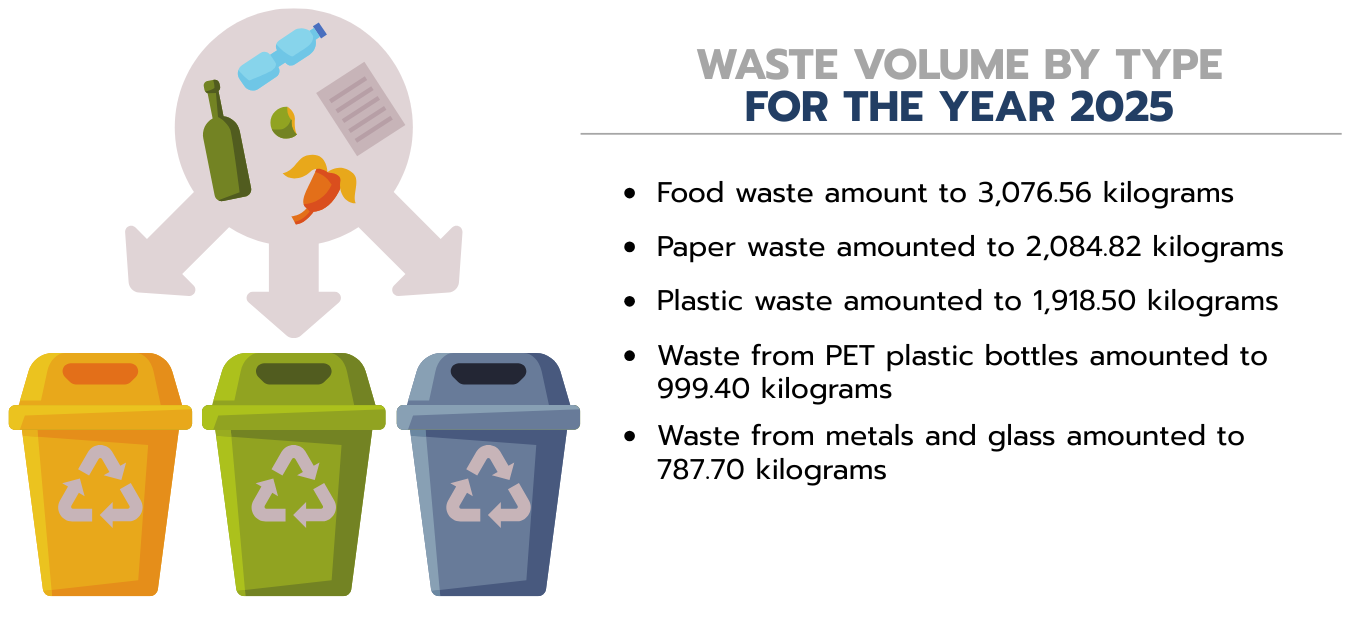
Following the implementation of the Waste and Refuse Management Plan, the Company has focused on reducing operational waste volumes, ensuring appropriate waste segregation, and managing refuse in compliance with applicable laws and standards — resulting in improved waste and refuse management efficiency within the organisation and a reduction in the environmental impact of business activities. The details are as follows.
1. Waste Segregation Prior to Disposal
The Company requires employees to continuously segregate waste prior to disposal, in order to promote cleanliness and orderliness in waste management within the organisation. In the short term, the Company focuses on ensuring correct daily waste segregation, while the long-term objective is to build employee knowledge and understanding, and to instil sustainable waste segregation behaviours — contributing to reduced waste volumes requiring disposal, lower greenhouse gas emissions, and more efficient resource use. To support these efforts, the Company has established waste segregation points in key areas within its buildings, such as dining areas and outside office areas on each floor, to facilitate appropriate waste segregation by employees. Waste segregation helps reduce total waste volumes and enables the Company to achieve cost savings on waste disposal.
In 2025, the Company implemented waste segregation across five main operational sites: the Head Office, Euro Creations Flagship Gallery / Thonglor 7 (T7), Euro Creations / Thonglor 5 (T5), Technogym Flagship Showroom / Ekkamai, and Euro Creations Flagship Gallery / Phuket. Operational sites located in Bangkok received fee discounts from the Bangkok Metropolitan Administration as a result of systematic waste segregation practices, reflecting the effectiveness of the organisation's waste management.
In addition, the Company successfully segregated 100% of hazardous waste — such as light bulbs and batteries — from general waste for proper disposal in accordance with applicable laws and standards.
2. No Bin on Desk Initiative
The Company has implemented the "No Bin on Desk" initiative by removing individual waste bins from employees' desks and replacing them with centralised waste disposal points on each floor, in order to promote correct waste segregation, reduce mixed waste disposal, and improve waste management efficiency within the organisation. The initiative encourages employees to become more aware of the volume of waste generated during their daily work and promotes responsible changes in resource use behaviour. Employees are required to bring their waste to centralised segregation points, which are clearly equipped with separate bins by waste type. The "No Bin on Desk" initiative forms part of the Company's Waste at Source management approach, helping to reduce waste volumes requiring disposal, lower waste management costs, and support environmentally friendly business operations over the long term.
3. Bring Your Own Bottle Initiative
The Company has implemented an initiative to reduce the use of single-use plastic water bottles within the organisation, encouraging employees to bring their own reusable bottles or cups for use in daily activities. During internal events, the Company requests that employees bring their own cups to reduce plastic waste from disposable containers.
Furthermore, at Board of Directors, Executive Committee, and management meetings, the Company has transitioned to serving drinking water in glasses rather than plastic bottles, setting a positive example for reducing plastic waste and promoting responsible resource use at all levels of the organisation. The initiative has helped reduce plastic waste from operations and supports ongoing behavioural change in resource use among employees and management, as part of the Company's long-term commitment to environmentally responsible business practices.
4. Reducing Waste from Work Processes
The Company has adopted digital technology as a key tool for transforming work practices, with the aim of reducing resource consumption and limiting operational waste generation. The focus is on reducing unnecessary paper use and consumables in daily work processes by transitioning communications and operations to electronic formats — such as holding shareholder meetings online and disclosing information and related documents through the Company's website rather than printing physical documents, thereby improving information accessibility while reducing resource consumption.
In terms of human resource management, the Company utilises the Humansoft digital system to support operations, including time and attendance recording, leave request submissions, and the electronic delivery of compensation-related documents — reducing document printing and improving data management efficiency.
The Company also encourages employees to consider the necessity of printing before doing so on each occasion, in support of efficient and environmentally responsible resource use.
5. Smart Packaging: Reuse and Reduce
The Company reuses packaging materials as part of its Waste at Source management approach, by storing and maintaining packaging boxes in ready-to-use condition for reuse in packing and transporting showroom display items, as well as for internal product movements — reducing unnecessary consumption of new packaging materials. As the majority of the Company's products are large in size and high in value, Unpack and Repack processes occur frequently. The Company therefore places importance on segregating reusable or recyclable packaging materials — such as foam, bubble wrap, and cardboard boxes — from general waste, in order to maximise their utility and minimise packaging waste.
This approach helps reduce natural resource consumption, minimise packaging waste, and manage material costs effectively, while promoting efficient resource use and supporting the Company's ongoing commitment to circular economy principles in its business operations.
GHG — Plan & Guidelines
Has a GHG Management Plan
Yes
Plan Description
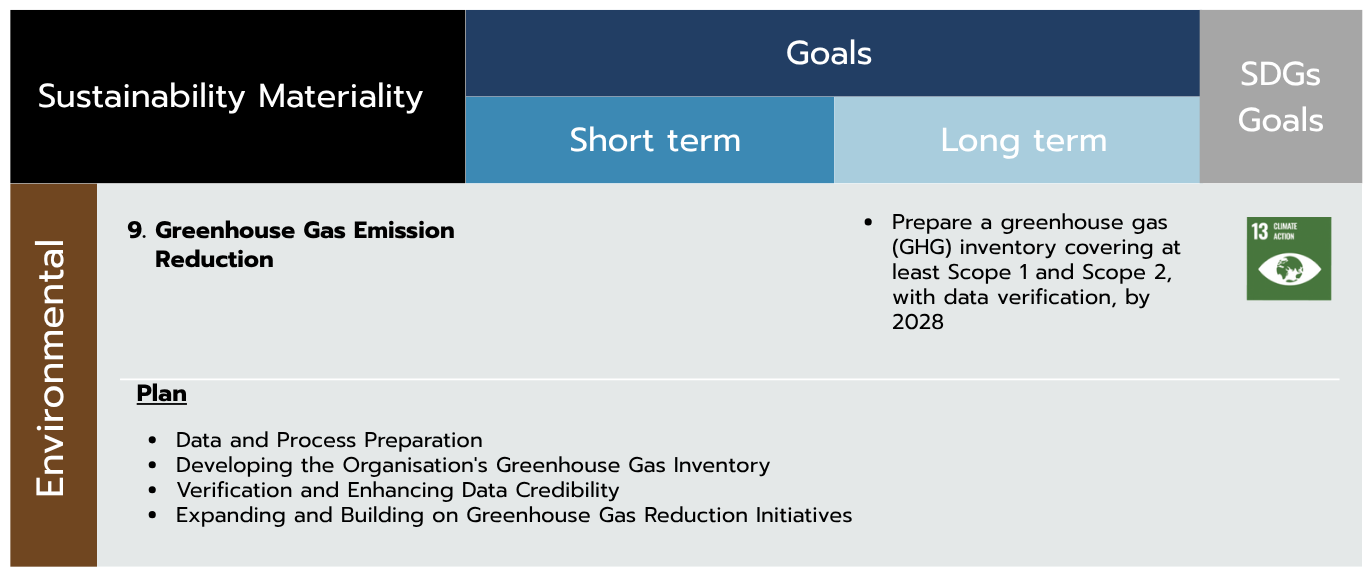
The Company recognises the importance of greenhouse gas management as one of the key factors affecting business sustainability and climate change, and has accordingly established a Greenhouse Gas Management Plan to elevate its environmental management practices, improve its capacity for data monitoring and disclosure, and prepare for the formulation of long-term greenhouse gas emission reduction measures. The Company's greenhouse gas management approach is defined as follows.
1. Data and Process Preparation
The Company will establish a data collection structure covering greenhouse gas emission-related activities — such as electricity consumption, fuel use, and transportation activities — with designated responsible parties and data management guidelines, to ensure that data is complete, consistent, and traceable.
2. Developing the Organisation's Greenhouse Gas Inventory
The Company will calculate and develop a greenhouse gas inventory in accordance with internationally recognised standards and guidelines, beginning with Scope 1 and Scope 2, to establish a clear understanding of the organisation's greenhouse gas emissions from its operations.
3. Verification and Enhancing Data Credibility
The Company plans to have its greenhouse gas inventory data verified by an external body, in order to build confidence in the accuracy of the data and elevate the organisation's environmental disclosure standards.
4. Expanding and Building on Greenhouse Gas Reduction Initiatives
The Company will use the results of its greenhouse gas inventory to identify significant emission sources and expand emission reduction measures to achieve broader coverage, including:
Improving energy efficiency and expanding the use of renewable energy.
Improving transportation and logistics operations to reduce fuel consumption.
Applying digital technology to reduce resource consumption and waste generation.
Promoting employee participation in reducing greenhouse gas emissions from work activities.
GHG — Emissions
GHG Emissions
| Metric |
|---|
| Total GHG emissions (Metric tonnes of carbon dioxide equivalent) |
| Total greenhouse gas emissions 1 (Metric tonnes of carbon dioxide equivalent) |
| Total greenhouse gas emissions 2 (Metric tonnes of carbon dioxide equivalent) |
| Total greenhouse gas emissions 3 (Metric tonnes of carbon dioxide equivalent) |
GHG — Emissions Verification
Emissions Verified by a Third Party
No
GHG — Principles & Standards
Principles & Standards Applied
| Standard |
|---|
| 2671 |
GHG — Targets
Introduction
Has Set GHG Targets
No
GHG — Performance & Outcomes
Has Performance Results
Yes
Performance Description
Following the Greenhouse Gas Management Plan, the Company has begun laying the foundations for systematic greenhouse gas emission management by preparing for the collection of data on energy and fuel-related activities, which represent key sources of greenhouse gas emissions.
The Company is currently in the process of collecting and analysing data on electricity consumption, transportation fuel use, and data from various departments, in order to improve accuracy and completeness, while enhancing data collection processes to enable monitoring and retrospective verification — forming an essential foundation for the development of a Scope 1 and Scope 2 greenhouse gas inventory.
These efforts position the Company to develop a credible greenhouse gas inventory and to use the resulting data to define emission reduction measures and targets in the next phase, as well as to elevate climate change-related disclosures in accordance with relevant standards.
In addition, the Company has continuously implemented greenhouse gas emission reduction measures related to energy use, including improving electrical energy efficiency, expanding the use of renewable energy, improving transportation processes, and applying digital technology to reduce resource consumption. These measures support the overall reduction of greenhouse gas emissions from operations. In 2025, the use of solar energy enabled the Company to reduce greenhouse gas emissions by 71,737.74 kilograms of carbon dioxide equivalent per year.
Environmental Legal Incidents
Legal Violation Incidents
| Metric | Current Year | Previous Year | Two Years Ago |
|---|---|---|---|
| Number of cases or incidents of legal violations or negative environmental impact (cases) | 0 | 0 | 0 |
Employees — Plan & Guidelines
Has an Employee Management Plan
Yes
Plan Description
The Company values its employees and workforce as the key resource driving its business, and has established a systematic approach to employee and workforce management under human rights principles, Thai labour laws, and relevant standards — covering recruitment and employment, people capability development, migrant worker management, and occupational health and safety management — to ensure that all employees are treated equally and fairly, and work in a safe environment.
The Company promotes employee communication and participation through internal organisational activities and feedback channels, alongside caring for quality of life through appropriate compensation, skills development, and welfare — to support work performance and the sustainable growth of the organisation. The Employee and Workforce Management Plan is defined as follows.
1. Fair Employee Compensation
The Company conducts market benchmarking to establish appropriate wage and compensation structures for each position, with annual salary adjustments considered in line with performance assessments, economic conditions, and inflation — to ensure that compensation is fair and competitive.
The Company operates a bonus system linked to both the Company's overall performance and individual employee performance, to provide appropriate motivation and reflect contributions. A Job Grading system is used to systematically classify positions, reviewed at least every three years. The Company also conducts satisfaction surveys on wages, compensation, and welfare, using the results to continuously improve its remuneration policies.
2. Employee Training and Development
The Company has established a systematic and continuous approach to employee development, utilising an Online Learning Platform alongside a Skill/Competency Matrix — used as tools to assess competencies, analyse skill gaps, and define development pathways appropriate to each employee's role.
The Company places importance on elevating sales and service skills through the Sales Academy framework, to support people readiness and the continuous transfer of knowledge within the organisation.
3. Promoting Employee Relations and Participation
The Company places importance on building positive relationships and employee participation, organising internal activities to promote communication, teamwork, and engagement among employees across different departments.
The Company provides opportunities for employees to express opinions through the Employee Engagement Survey and Inter-departmental Survey, using the results to improve policies, the working environment, and work processes for greater efficiency.
4. Strengthening Occupational Health and Safety
The Company establishes a systematic approach to occupational health and safety management in compliance with labour laws and relevant standards, with a focus on accident prevention, risk control, and the creation of a safe working environment for employees and relevant stakeholders. The Company's safety operational framework covers the provision and maintenance of personal protective equipment, safety communications and training, and the continuous monitoring and review of safety measures — to ensure that safety management is effective and appropriate to the nature of the organisation's operations.
5. Fair Employment of Migrant and Foreign Workers
The Company establishes guidelines for managing migrant workers in full compliance with Thai labour laws, treating migrant workers equally to Thai employees in all respects — including wages, benefits, working hours, and working conditions — without discrimination.
The Company's operational framework requires thorough verification of all relevant employment documentation, alongside the provision of occupational health and safety standards on an equal basis — enabling migrant workers to perform their duties with stability, appropriateness, and in accordance with human rights principles.
6. Prevention of Child Labour
The Company places importance on protecting human rights and conducting business responsibly, and has established guidelines for preventing child labour in its direct employment processes — adhering strictly to labour laws and relevant international principles. The Company verifies the age and identity documents of all job applicants prior to employment, to ensure that no workers below the legally stipulated minimum age are hired.
Plan Areas
| Plan Area |
|---|
| Fair employee compensation |
| Employee training and development |
| Promoting employee relations and participation |
| Migrant/foreign labor |
| Child labor |
| Occupational health and safety in workplace |
Employees — Workforce
Workforce Data
| Metric | Current Year | Previous Year | Two Years Ago |
|---|---|---|---|
| Total number of employees (Persons) | 331 | 306 | 287 |
| Number of male employees (Persons) | 137 | 120 | 121 |
| Number of female employees (Persons) | 194 | 186 | 166 |
| Total employment of disabled persons (people) | 0 | 0 | 0 |
| Total disabled employees (people) | 0 | 0 | 0 |
| Total male disabled employees (people) | 0 | 0 | 0 |
| Total female disabled employees (people) | 0 | 0 | 0 |
| Total disabled workers who are non-employee (people) | 0 | 0 | 0 |
| Contributions to the fund for promoting and improving the quality of life for disabled persons | 1 | 1 | 1 |
| Total number of male employees in operational level (Persons) | 114 | 100 | 96 |
| Total number of male employees in management level (Persons) | 19 | 17 | 22 |
| Total number of male employees in executive level (Persons) | 4 | 3 | 3 |
| Total number of female employees in operational level (Persons) | 149 | 143 | 115 |
| Total number of female employees in management level (Persons) | 42 | 40 | 48 |
| Total number of female employees in executive level (Persons) | 3 | 3 | 3 |
Employees — Remuneration & Provident Fund
Remuneration & Provident Fund
| Metric | Current Year | Previous Year | Two Years Ago |
|---|---|---|---|
| Total disabled employees (people) | 253,865,812.78 | 236,521,237.3 | 180,621,678.07 |
| Total male employee remuneration (Baht) | 101,915,640.81 | 88,266,263.94 | 66,175,712.74 |
| Total female employee remuneration (Baht) | 151,950,171.97 | 148,254,973.36 | 114,445,965.33 |
| Number of employees eligible to participate in PVD (persons) | 310 | 293 | 258 |
| Total number of employees joining employee provident fund (Persons) | 188 | 165 | 159 |
| Percentage of total number of employees joining employee provident fund to total number of employees (%) | 56.8 | 53.92 | 55.4 |
| Number of PVD members / Total eligible employees (%) | 60.65 | 56.31 | 61.63 |
| Total amount of provident fund contributed by the Company (Baht) | 4,963,075.88 | 4,265,716 | 3,742,456 |
| Total amount of provident fund contributed by employee (baht) | 4,963,075.88 | 4,265,716 | 3,742,456 |
Employees — Training & Development
Training Data
| Metric | Current Year | Previous Year | Two Years Ago |
|---|---|---|---|
| Average employee training hours (Hours / Person / Year) | 16 | 12 | 9.87 |
| Employee development and training expenses (baht) | 1,900,016.51 | 818,964 | 2,106,394 |
Employees — Occupational Health & Safety
Occupational Health & Safety Data
| Metric | Current Year | Previous Year | Two Years Ago |
|---|---|---|---|
| Total number of lost time injury incidents by employees (Cases) | 0 | 0 | 1 |
Employees — Labour Relations
Labour Relations Data
| Metric | Current Year | Previous Year | Two Years Ago |
|---|---|---|---|
| Total voluntary resignations (Persons) | 40 | 60 | 81 |
| Male employees who voluntary resigned (Persons) | 9 | 17 | |
| Female employees who voluntary resigned (Persons) | 31 | 43 | |
| Percentage of employee turnover leaving the Company voluntarily (%) | 12.08 | 19.61 | 28.22 |
| Evaluation result of employee engagement | 1 | 1 | 0 |
Employees — Employee Representation
Employees Are Represented Collectively
No
Employees — Targets
Introduction
Has Set Employee Targets
Yes
Targets
| Indicator | Target Areas | Target Year | Target Year — Description |
|---|---|---|---|
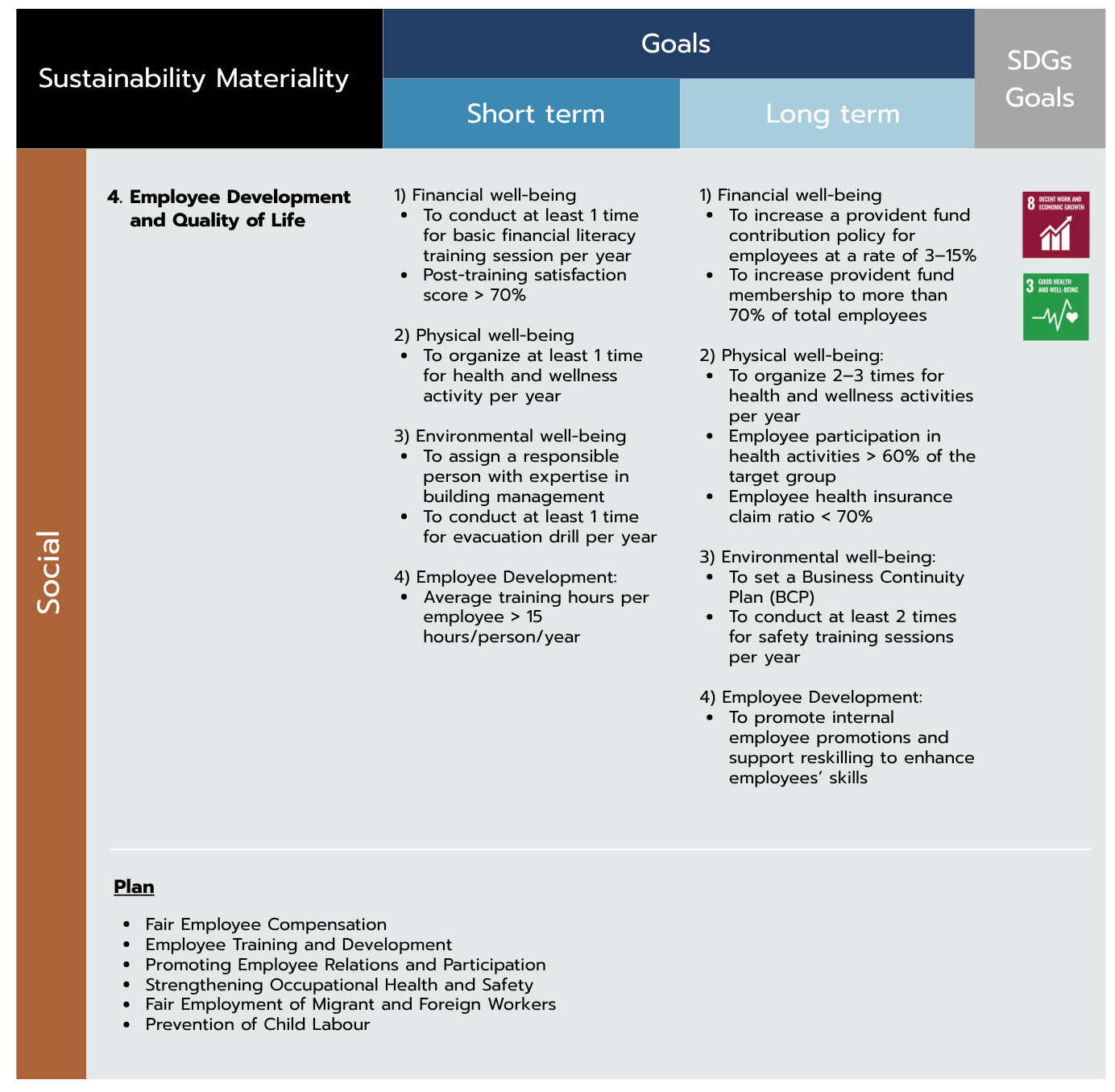
| Employee Development & Well-being | 2984 · Description: Employee training and development · 2983 · Description: Fair employee compensation · 2985 · Description: Promoting employee relations and participation · 2988 · Description: Safety and occupational health at work · 2989 · Description: Non-discrimination | 2,025 | 1) Financial well-being
- To conduct at least 1 time for basic financial literacy training session per year
- Post-training satisfaction score > 70%
2) Physical well-being
- To organize at least 1 time for health and wellness activity per year
3) Environmental well-being
- To assign a responsible person with expertise in building management
- To conduct at least 1 time for fire evacuation drill per year
4) Employee Development
- Average training hours per employee > 15 hours/person/year |
Employees — Performance & Outcomes
Has Performance Results
Yes
Performance Description
1. Fair Employee Compensation
In 2025, the Company implemented an average salary increase of 7% and paid annual bonuses averaging 2.5 months of salary. Salary adjustments and compensation decisions were made in accordance with the Company's defined framework and criteria, taking into account individual performance assessments, Job Grading structure, the Company's overall operating results, and prevailing economic conditions — to ensure fairness, appropriateness, and market competitiveness.
In the same year, the Company's total employee compensation amounted to Baht 253,865,812.78, comprising Baht 101,915,640.81 for male employees and Baht 151,950,171.97 for female employees, representing an average compensation ratio of female to male employees of 1:1.49 — reflecting compensation determined on the basis of roles, responsibilities, and performance, without discrimination on grounds of gender.
Salary adjustments and bonus payments varied according to individual performance assessment ratings, in order to appropriately reflect contributions and provide motivation. The Company communicated individual compensation outcomes to employees through their respective line managers, to ensure clarity, transparency, and a correct understanding of the assessment criteria.
2. Employee Training and Development
In 2025, the Company implemented systematic employee capability development, achieving an average of 16.01 learning hours per person per year, to strengthen employee readiness in alignment with their roles and the organisation's growth direction. The Company supports learning through formats appropriate to each role, encompassing classroom training, Online Learning Platforms, and On-the-job Training, to ensure flexible and accessible development opportunities for all employees.
The Company's people development initiatives cover both Hard Skills and Soft Skills, with programmes tailored to different target groups and role requirements, including:
Leadership Development Programme for supervisors and management, to strengthen leadership, teamwork, and people management capabilities.
Business and Service Skills Development Programme through the Sales Academy, new employee orientation, and internal process-related courses, to build business understanding and service standards.
Safety, Occupational Health, and Information Technology Development Programme, covering workplace safety training — such as fire evacuation drills — and cybersecurity training, to address operational risks.
To elevate the effectiveness of learning, the Company has developed a Skill/Competency Matrix for key positions, with the Human Resources department and line managers jointly assessing employee skill and competency levels, and using the results to analyse Skill Gaps and assign appropriate individual learning programmes through the Online Learning Platform — ensuring that development is targeted and aligned with actual role requirements.
In addition, the Company places importance on transferring knowledge and experience from management to employees directly, through a Mentoring/Coaching programme in which senior management serve as coaches and mentors on a one-to-one basis, to develop strategic thinking, problem-solving, and real-world working skills — a form of learning that cannot be fully replicated through classroom training alone. This approach enables employees to develop their capabilities rapidly and precisely, while fostering strong relationships between management and employees at all levels, forming an essential foundation for building organisational competitiveness and long-term sustainability.
3. Promoting Employee Relations and Participation
In 2025, the Company continuously implemented activities and programmes to promote employee engagement and participation, with a focus on creating a working environment conducive to communication, collaboration, and teamwork across the organisation — including employee relations activities and internal communications initiatives.

The Company organised internal activities to strengthen relationships among employees from different departments, including a New Year Party under the Monochromatic theme on 24 January 2025, which provided employees at all levels with the opportunity to interact and participate in activities together, fostering closer connections and internal collaboration.
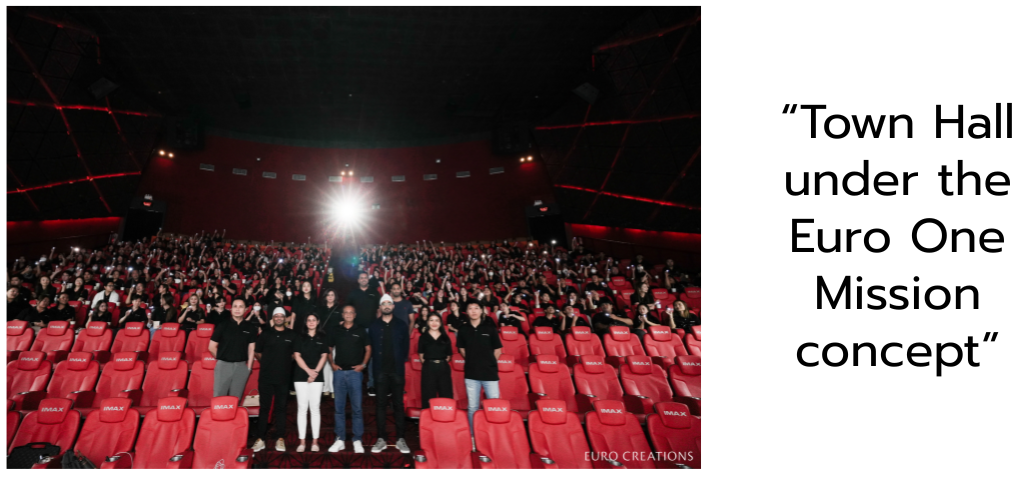
In addition, the Company organised Town Hall and Mini Town Hall sessions under the "Euro One Mission" concept, totalling three sessions in 2025, as follows:
Session 1: Mini Town Hall on 31 March and 1 April 2025
Session 2: Town Hall on 10 June 2025
Session 3: Mini Town Hall on 25–26 September 2025
These sessions were held to communicate the Company's vision, strategic direction, and key organisational information to employees at all levels. The sessions provided opportunities for two-way communication between management and employees, enabling employees to express opinions and offer suggestions on various matters — including welfare and quality of working life — which management and the Human Resources department use as input for continuously improving employee welfare and care practices. This reflects a systematic approach to gathering employee feedback on welfare matters and promoting organisational-level employee participation.
In terms of employee feedback, the Company conducted an Employee Engagement Survey, achieving a response rate of 80%. The results indicated an employee engagement score of 72%, an improvement from the previous year (2024: 63%). The Company also conducted an Inter-departmental Survey, which showed an average satisfaction score of 3.62 (2024: 3.48), reflecting improvements in cross-departmental coordination and collaboration.
4. Fair Employment of Migrant and Foreign Workers
In 2025, the Company employed migrant workers in certain positions consistent with its operational requirements, in full compliance with Thai labour laws, and treated migrant workers equally to Thai employees in all respects — including wages, benefits, working hours, and working conditions.
The Company verified the completeness of all employment documentation for migrant workers — including work permits, social security registration, and timely renewal of relevant documents — and ensured that occupational health and safety standards were applied equally, enabling migrant workers to perform their duties with stability, appropriateness, and in accordance with human rights principles.
5. Prevention of Child Labour
The Company has a policy of zero child labour and does not support any form of unlawful labour practices, in strict compliance with Thai labour laws. In 2025, the Company verified the age of all job applicants prior to employment through relevant official documents, to prevent the hiring of workers below the legally stipulated minimum age.
Based on human resource management operations and reviews conducted during the reporting year, the Company found no instances of child labour, reflecting responsible workforce management practices consistent with human rights principles and applicable laws.
6. Occupational Health and Safety
In 2025, the Company recorded no serious accidents or fatalities arising from work operations. However, one minor incident occurred involving an installation team member who was struck by falling material during operations. The employee received appropriate first aid and medical care and was able to return to work as normal.
Following the incident, the Company reviewed and improved its safety practices for installation work, implementing stricter standards for worksite preparation, the use of Personal Protective Equipment (PPE), and operational supervision, to prevent recurrence of similar incidents.
The Company has designated a responsible person for safety and building management directly, to monitor, inspect, and oversee safety measures at all operational sites on an ongoing basis, and to coordinate with relevant departments in addressing issues and improving the working environment. Having clearly designated responsibility enables the Company to respond to safety risks promptly and effectively.
In addition, the Company continuously promotes safety knowledge and awareness by organising safety training and fire evacuation drills — covering both theoretical and practical components — on 14 November 2025, to ensure that employees have the knowledge, understanding, and ability to respond correctly in emergency situations, reflecting the Company's commitment to the ongoing and sustainable care of employee occupational health and safety.
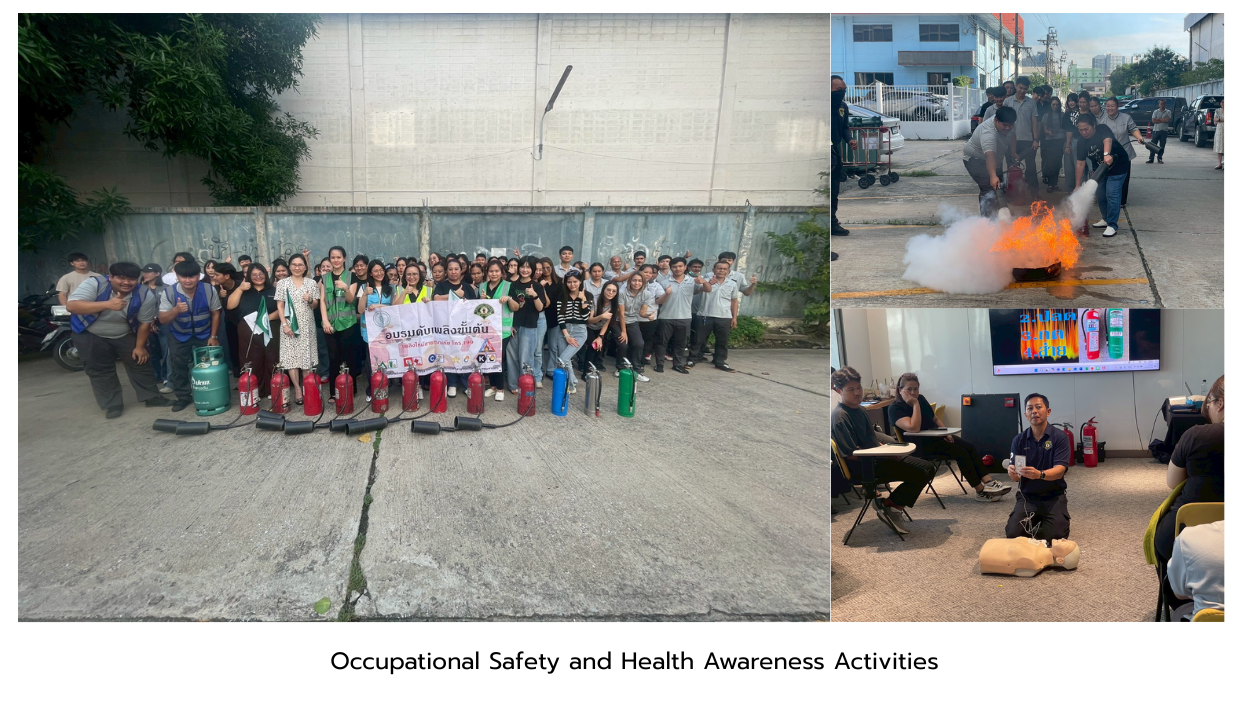
7. Promoting Employee Well-being
Financial Well-being:
The Company recognises the importance of financial security as a foundation for employees' quality of life, and has continuously organised financial literacy activities throughout 2025 in collaboration with UOB Bank as a financial expert — covering two key activities: financial planning and savings advisory services on 14 March 2025, and knowledge sharing on the Provident Fund (INVC) to prepare employees for retirement on 22 October 2025.
Feedback from participating employees reflected a high level of programme effectiveness. Satisfaction scores for content relevance and speaker expertise were 83.3%, while 75.0% of participants indicated they could apply the knowledge in practice. Notably, 92% of participants expressed willingness to recommend the programme to fellow employees, reflecting the value delivered and the clear success of the initiative.
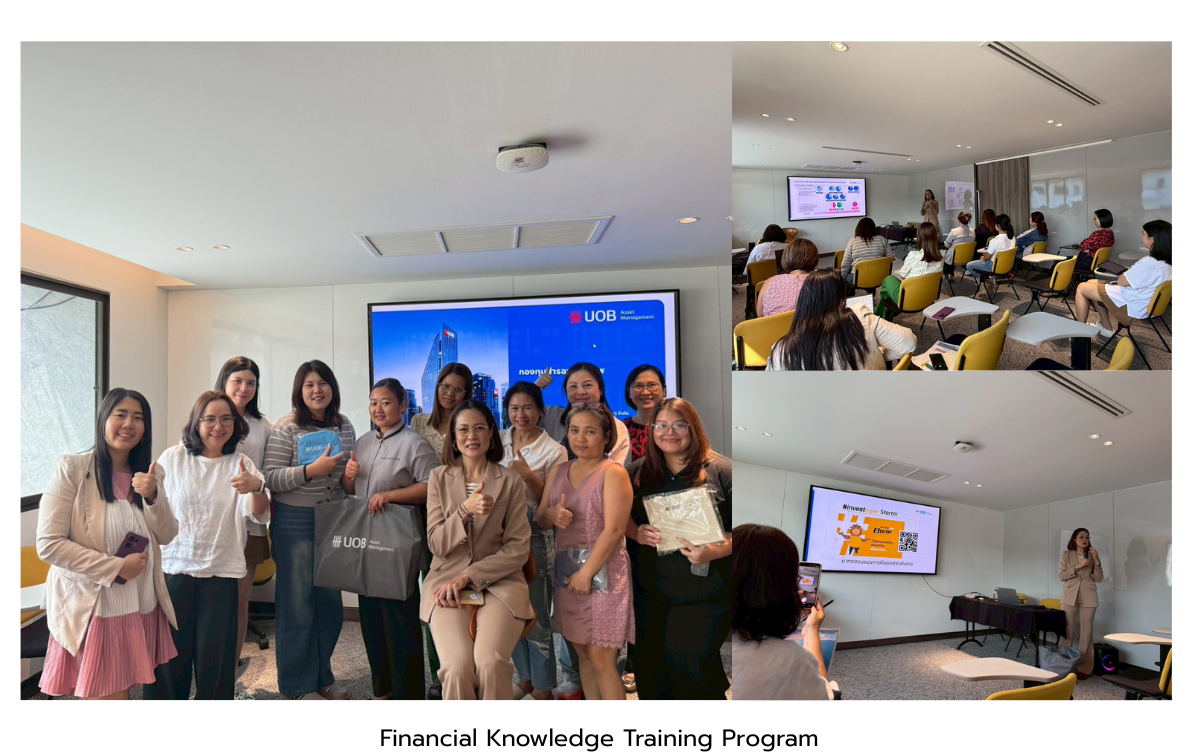
Physical Well-being:
The Company places importance on promoting employees' physical health in a comprehensive and continuous manner. In 2025, the Company implemented health promotion activities in multiple formats, including yoga sessions held continuously from August to December 2025 to support physical and mental balance, and annual health check-ups provided to all employees for preventive healthcare. In addition, employees receive the benefit of access to a professionally equipped gym facility featuring Technogym equipment, with guidance provided by knowledgeable colleagues to ensure correct and safe exercise practices. These activities reflect the Company's concrete commitment to caring for the health and quality of life of its employees.
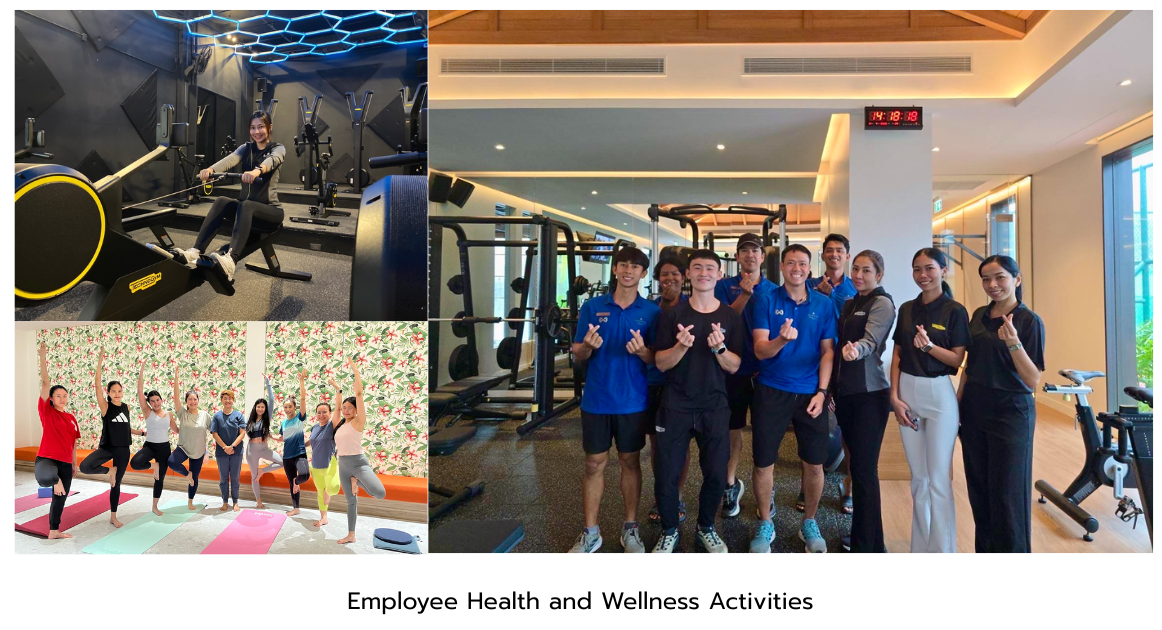
8. Employment of Persons with Disabilities
In 2025, the Company has not yet directly employed persons with disabilities. However, the Company has complied with the Persons with Disabilities Empowerment Act B.E. 2550 by providing financial support for the occupational development of persons with disabilities or their caregivers under Section 35, in full and timely accordance with the legally defined timeframe, in a total amount of Baht 361,350.
This reflects the Company's compliance with legal requirements and its commitment to supporting and promoting occupational opportunities for persons with disabilities and their caregivers, in order to enhance quality of life and foster social equality in an appropriate manner.
Customers — Plan & Guidelines
Has a Customer Management Plan
Yes
Plan Description
The Company recognises the importance of delivering experiences that exceed customer expectations, encompassing the responsible, transparent, and internationally standardised provision of products and services — from the product curation process to information sharing and consultancy — with the aim of creating satisfaction and delivering an exceptional experience to customers. The Company is guided by principles of attentive, sincere, professional, and responsible service, while placing importance on building sustainable customer relationships, promoting engagement, and welcoming feedback to develop products and services that genuinely meet customer needs.
In addition, the Company places importance on elevating after-sales service, presenting accurate, clear, and comprehensive information to enable informed customer decision-making, and continuously improving communication channels to ensure ease of access, speed, and efficiency. Creating a positive customer experience is at the heart of sustainable business operations, and the Company has accordingly defined the following customer management policies and approaches.
1. Responsible Product and Service Curation
The Company establishes a responsible approach to product and service curation, placing importance on sourcing products and selecting brands of quality that are certified to relevant standards — to ensure that products are safe, appropriate for use, and pose no risk to customers. In parallel, the Company develops the knowledge and understanding of relevant personnel through quality inspection training, as well as guidelines for safe importation, delivery, and installation — to ensure that product and service delivery meets defined standards and continuously builds customer confidence.
2. Delivering an Exceptional Customer Experience
The Company places meticulous importance on every interaction between customers and the organisation, encompassing showroom ambience and aesthetics, team professionalism, the curation of high-quality and diverse products, and comprehensive living solutions — including expert delivery and installation services, high-standard after-sales care, and strict customer personal data protection measures. The Company pursues an Ecosystem Clustering strategy in the Thonglor district, connecting its showroom network across Thonglor 7 (T7) and Thonglor 5 (T5) to enable customers to experience and select living solutions from a wide range of brands in the same vicinity — an ecosystem that will be further completed upon the opening of Euro Creations / Thonglor 3 (T3) in the fourth quarter of 2026. All of this is aimed at elevating the customer experience beyond expectations and building the highest level of confidence and trust at every stage of Euro Creations' service delivery.
3. Communicating Product and Service Information to Customers and Consumers
The Company provides clear information on product features, usage, and quality through consultancy delivered by well-trained specialist teams, enabling accurate and comprehensive brand information to be communicated to customers in full.
4. Developing Customer Satisfaction and Building Customer Relationships
The Company is committed to elevating customer satisfaction and building long-term customer relationships, placing importance on quality and service at every stage — particularly after-sales service (Customer Service). The Company has established a continuous approach to developing after-sales service, focusing on reducing problem resolution times, improving coordination efficiency, and ensuring timely product and service delivery, in order to enhance the customer experience and build confidence.
In addition, the Company has commenced the implementation of a Customer Satisfaction Survey during 2025, to serve as a concrete tool for evaluating service performance and using the results as input for improving products, services, and work processes to better meet customer needs.
5. Protection of Customer Personal Data
The Company places importance on the protection of customer personal data, collecting, using, and disclosing personal data appropriately and in compliance with the Personal Data Protection Act (PDPA). Customer data is used only for the purposes for which consent has been obtained — such as product delivery, service provision, and after-sales contact.
The Company has established channels and processes for receiving complaints or concerns regarding customer personal data — including contact via email, telephone, and relevant online channels — with a trained team responsible for monitoring, reviewing, and taking appropriate and timely corrective action, to build customer confidence in the safety and protection of their personal data.
Plan Areas
| Plan Area |
|---|
| Responsible production and services for customers |
| Communication of product and service impacts to customers/consumers |
| Development of customer satisfaction and customer relationship |
| Protection of customer personal information |
Customers — Satisfaction Results
Customer Satisfaction Results
| Metric | Current Year | Previous Year | Two Years Ago |
|---|---|---|---|
| Evaluation results of customer satisfaction | 1 | 0 | 0 |
Customers — Targets
Introduction
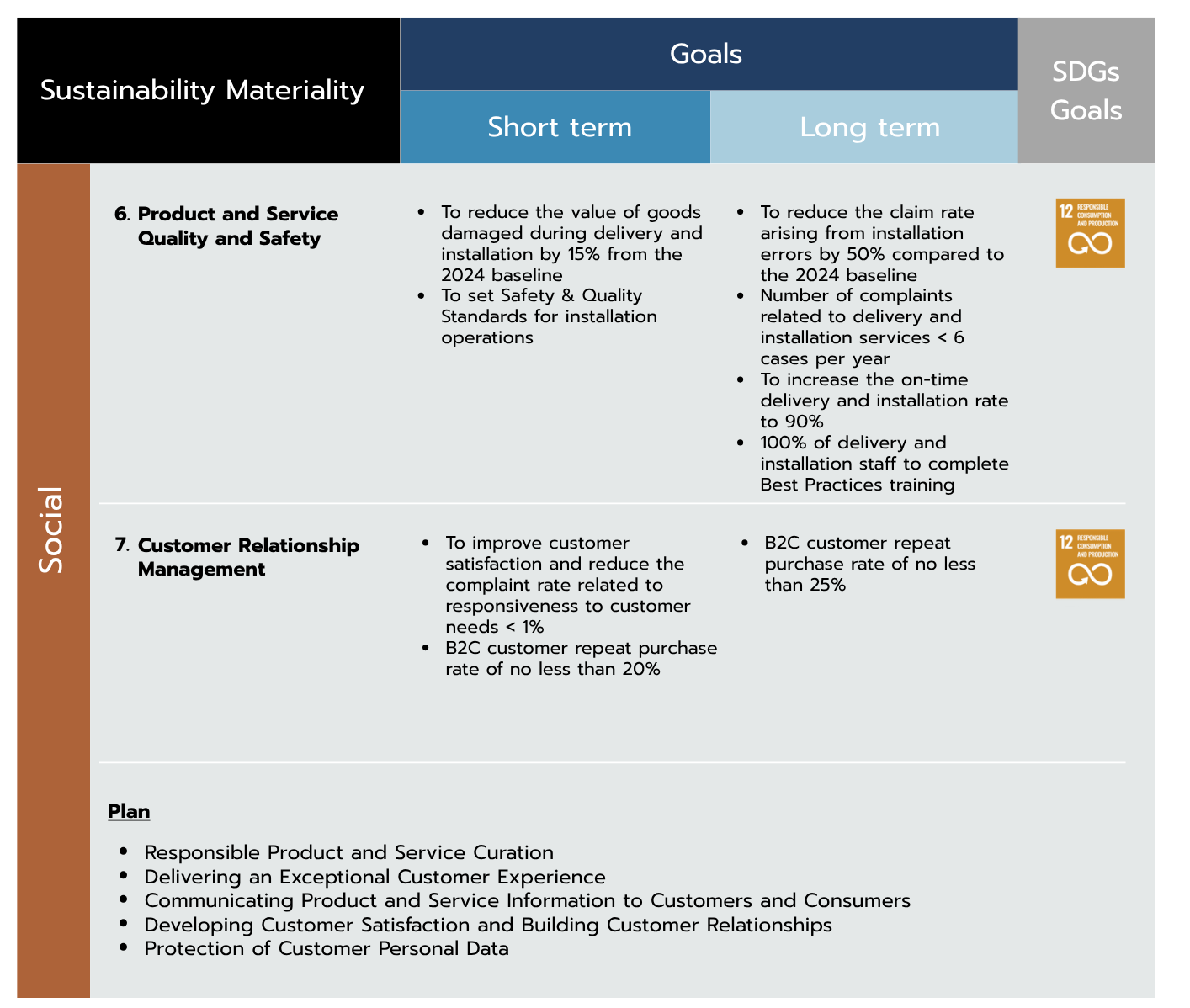
Has Set Customer Targets
Yes
Targets
| Indicator | Target Areas | Base Year | Target Year | Target Year — Description |
|---|---|---|---|---|
| - | 3007 · Description: Responsible production and services for customers · 3008 · Description: Communication of product and service impacts to customers/consumers · 3009 · Description: Development of customer satisfaction and customer relationship · 3010 · Description: Consumer data privacy and protection | 2,024 | 2,025 | - To reduce the value of goods damaged during delivery and installation by 15% from the 2024 baseline
- To set Safety & Quality Standards for installation operations
- To improve customer satisfaction and reduce the complaint rate related to responsiveness to customer needs < 1%
- B2C customer repeat purchase rate of no less than 20%
|
Customers — Performance & Outcomes
Has Performance Results
Yes
Performance Description
In 2025, the Company continuously implemented customer care and customer experience enhancement initiatives, with a focus on delivering products and services of quality, transparency, and in accordance with the Company's service standards — for both retail customers (Business-to-Consumer: B2C) and business customers (Business-to-Business: B2B). The customer management performance results are as follows.
1. Responsible Product and Service Curation
In 2025, the Company continuously curated products and services from manufacturers and brands that meet internationally recognised standards for quality, safety, and environmental responsibility, with the aim of reducing consumer safety risks alongside promoting the presentation of sustainably produced goods to create long-term value for customers.
The majority of products imported and distributed by the Company are European brands, which operate under stringent legal and regulatory frameworks governing quality, safety, and environmental standards — used as one of the key criteria in the product selection process, including the EU Product Safety Framework, regulations governing chemicals that may be harmful to consumers (such as REACH), and environmental requirements related to production processes and supply chains.
The brands for which the Company serves as distributor in Thailand — including Molteni&C, Poltrona Frau, Gessi, Technogym, and Bang & Olufsen — all operate under environmental management systems (UNI ISO 14001 Environmental Management System) and quality management standards such as UNI EN ISO 9001 or internationally equivalent standards.
In its operations, the Company regularly monitors and reviews product standards in collaboration with brand owners, alongside training sales and service personnel to maintain thorough knowledge and understanding of each brand's standards — to ensure that information and services are provided to customers accurately, comprehensively, and professionally.
In 2025, the Company recorded no instances of products or services failing to meet safety standards, and received no customer complaints relating to product safety standards, reflecting the effectiveness of the Company's ongoing product curation and quality oversight processes.
2. Showroom Openings to Elevate the Customer Experience
In 2025, the Company continued to invest in expanding and developing its showrooms to elevate the customer experience and facilitate access to the Company's products and services, creating spaces that enable customers to experience products, explore design concepts, and receive expert consultancy in a more comprehensive and personal manner.
The showroom openings during the past year formed part of the Company's customer management operations, designed to address customer needs in terms of accessibility, hands-on product experience, and confidence in product and service quality, including:
Bang & Olufsen Pop-up Store / Emporium, operating from February to May 2025, to expand product accessibility and create brand awareness experiences for customers at a prime retail location.
Euro Creations / Thonglor 5 (T5), comprising the Poltrona Frau Flagship Store and Molteni&C Flagship Store — a comprehensive luxury showroom spanning three floors — enabling customers to experience and select premium living solutions from leading brands in their most complete form.
Bang & Olufsen Flagship Store / Central Embassy, the brand's first flagship store in Thailand, presenting audio and design experiences through dedicated product trial areas and specialist consultancy zones.
These showroom openings and developments are consistent with the Company's Ecosystem Clustering strategy in the Thonglor district, connecting the showroom network across Euro Creations Flagship Gallery / Thonglor 7 (T7) and Euro Creations / Thonglor 5 (T5) — enabling customers to experience and select living solutions from a wide range of brands within the same vicinity. This ecosystem will be further completed upon the opening of Euro Creations / Thonglor 3 (T3) in the fourth quarter of 2026. These initiatives deepen the customer experience, improve accessibility to products and services, and support customer decision-making through hands-on product experience and expert guidance — key factors in building customer satisfaction, confidence, and long-term relationships.
3. Communicating Product and Service Information to Customers and Consumers
The Company places importance on communicating product and service information accurately, completely, and transparently to support informed customer decision-making. The Company prepares product documentation and manuals that detail materials, care instructions, and basic safety guidance, while providing ongoing consultancy throughout the service process.
All advertising and public relations communications are conducted on the basis of factual product attributes and features, without causing misunderstanding, to ensure that customers receive accurate and complete information prior to making purchasing decisions.
In addition, the Company provides Brand Specialists with in-depth product and brand knowledge to deliver information, advice, and detailed technical and usage explanations to customers, alongside continuously developing the capabilities of sales and service personnel through the Sales Academy programme — to elevate the quality of consultancy and product presentation in a manner that is accurate, targeted, and consistent with each brand's standards. This enhances customer understanding, increases confidence in product usage, and systematically elevates the quality of the Company's product and service communications.
4. Developing Customer Satisfaction and Building Customer Relationships
In 2025, the Company commenced the development of a more comprehensive Customer Satisfaction Survey system, encompassing both online and questionnaire formats across showrooms and digital channels, to serve as a concrete tool for measuring satisfaction across all service dimensions and using the results for systematic improvement going forward.
The Company has also added a Line for Business communication channel to facilitate customer enquiries, order status tracking, and after-sales issue reporting quickly and efficiently — enhancing ease of contact and continuity of customer care.
In terms of service quality, the Company conducts quality inspections of products and services at every stage prior to delivery to customers. Sales and service personnel receive regular training in accordance with each brand's standards. The Company has also established key performance indicators (KPIs) across relevant departments — including warehouse management, safe delivery, and after-sales service — to maintain consistent quality and service efficiency in line with customer expectations.
In 2025, the Company's customer repeat purchase rate stood at 20%. In the context of a luxury goods business where product values are high and customer decision-making cycles are relatively long, this rate serves as an important indicator that the Company will continue to monitor and use as a basis for developing service quality going forward.
5. Elevating After-Sales Service and Product Delivery
In 2025, the Company placed importance on improving the quality of after-sales service and product delivery as a key mechanism for building customer satisfaction, confidence, and long-term relationships — particularly among luxury customers who have high expectations for product quality, safety, and service standards consistent with brand image.
The Customer Service and delivery teams collaboratively developed and improved work processes, focusing on delivering an On-site Customer Experience that is orderly, safe, and professional — with careful regard for customers' property, the safety of residents, and tidiness throughout the duration of all on-site operations — so that delivery and installation become part of the overall impression and reinforce brand value.
The Company elevated its field operation standards by introducing specialist anti-impact floor protection mats for use during furniture installation — to protect residential surfaces from damage, reduce the risk of scratches or impact from heavy equipment, and clearly delineate work areas — thereby improving orderliness and reducing the risk of accidents during operations.
The Company also established cleanliness and professionalism standards for delivery and installation teams by requiring team members to wear white gloves during product assembly and installation, to minimise contact with product surfaces, prevent fingerprints or soiling, and reinforce a professional service image at customers' residences.
In 2025, the value of products damaged during delivery and installation stood at Baht 1.01 million, representing 0.07% of the Company's total revenue, and a reduction of 51% from the 2024 baseline — a development of meaningful significance in terms of both cost control and the maintenance of service standards. The Company will use this data as a basis for setting targets and continuously improving its field operations going forward.
These efforts reflect the Company's commitment to elevating after-sales service quality, caring for customers with attention to every detail, and conducting business in a manner consistent with luxury product standards and a high-quality lifestyle. The Customer Satisfaction Score (CSAT) from after-sales service in 2025 achieved an average of 4.99 out of 5.00, reflecting an outstanding level of customer satisfaction.
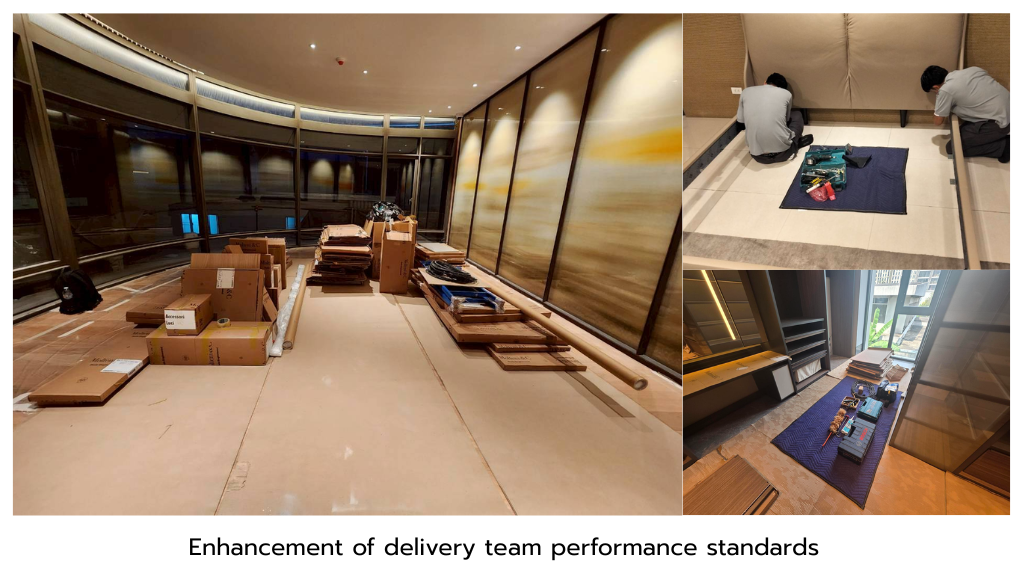
6. Protection of Customer Personal Data
In 2025, the Company managed customer personal data systematically, under good governance principles and in strict compliance with the Personal Data Protection Act (PDPA). The Company has established a personal data protection policy and published a privacy policy on its website to ensure transparent access for customers and stakeholders. Throughout 2025, the Company recorded no customer personal data breach incidents, reflecting the effectiveness of the data security measures continuously implemented by the Company.
The Company provides channels for customers to submit feedback, complaints, or whistleblowing reports through designated systems, and uses such input to continuously improve product and service quality. Upon receipt of a complaint, the Company investigates the facts and takes action in accordance with the processes defined in its Complaint and Whistleblowing Policy.
Customer complaint channels | |
Telephone: | 02-744-9624 |
Website: | www.eurocreations.co.th |
Post: | 1050 Soi Sukhumvit 66/1, Sukhumvit Road, Phrakanong Tai, Phrakanong, Bangkok 10260 |
Customer Relationship Activities
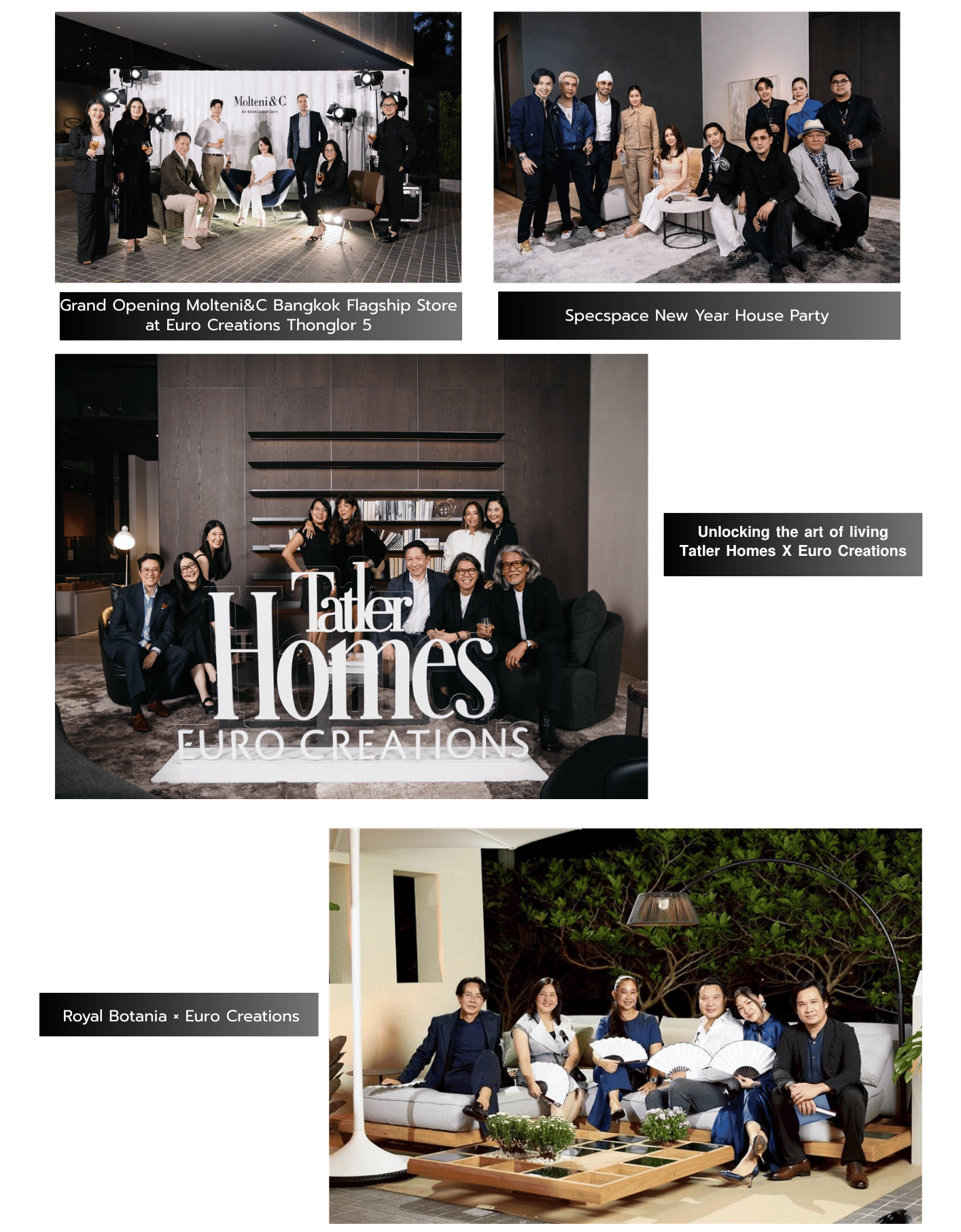
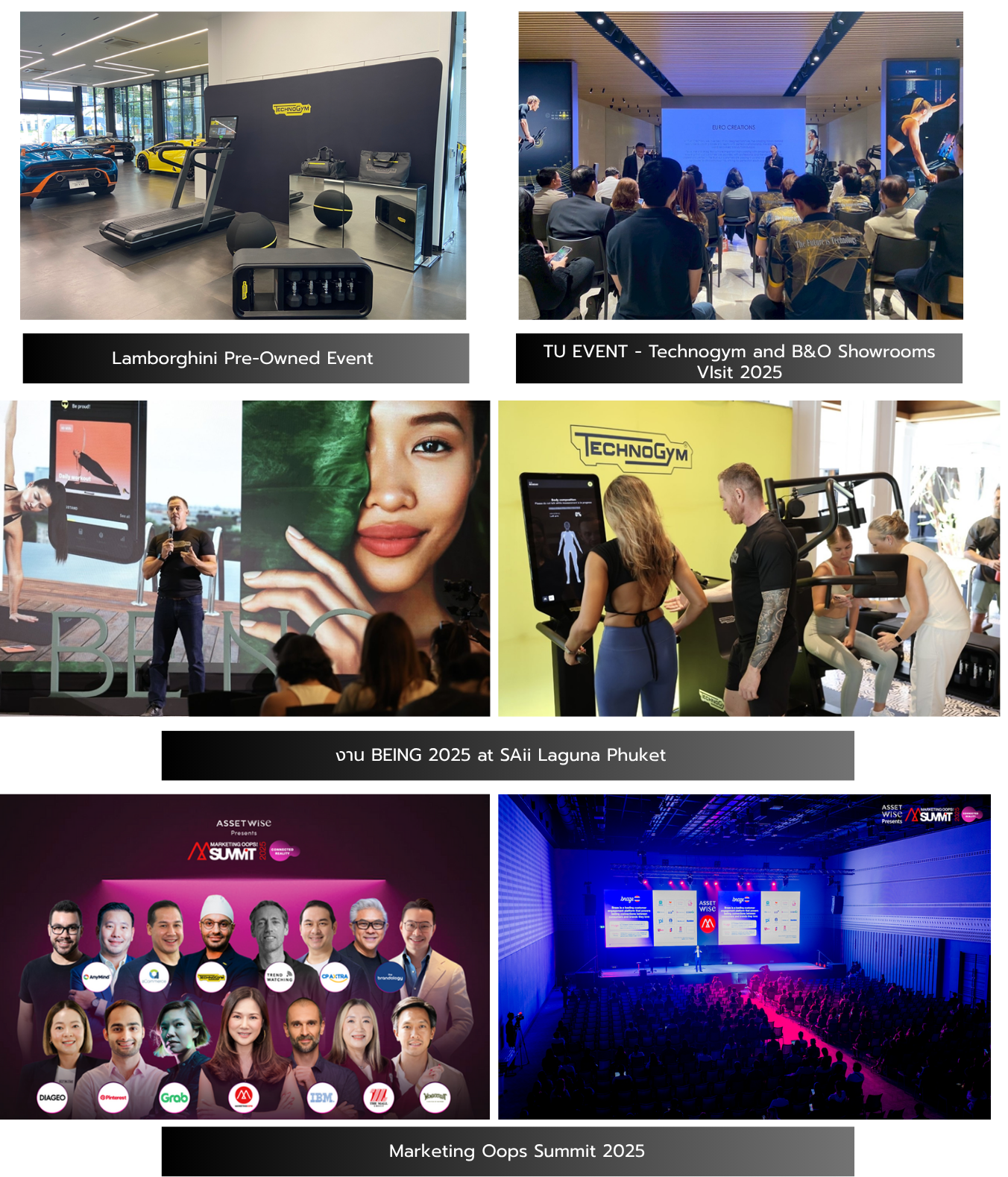
Community & Social — Plan & Guidelines
Has a Community & Social Plan
Yes
Plan Description
The Company recognises its role and responsibility towards communities and society as an integral part of sustainable business operations, and is committed to striking a balance between business growth and improving the quality of life of communities. The Company supports the implementation of social contribution activities designed to appropriately address community needs and challenges, placing importance on creating opportunities, developing capabilities, and strengthening communities to enable long-term self-reliance.
The Company's corporate social responsibility activities encompass education, support for disadvantaged individuals and vulnerable groups, and the promotion of health, safety, and quality of life. The Company carries out these activities within a framework of community participation, feedback, and appropriate monitoring — to ensure that community and social development progresses hand in hand with the sustainable growth of the organisation.
Plan Areas
| Plan Area |
|---|
| Education |
| Occupational health, safety, health, and quality of life |
| Disadvantaged and vulnerable groups |
Community & Social — Targets
Introduction
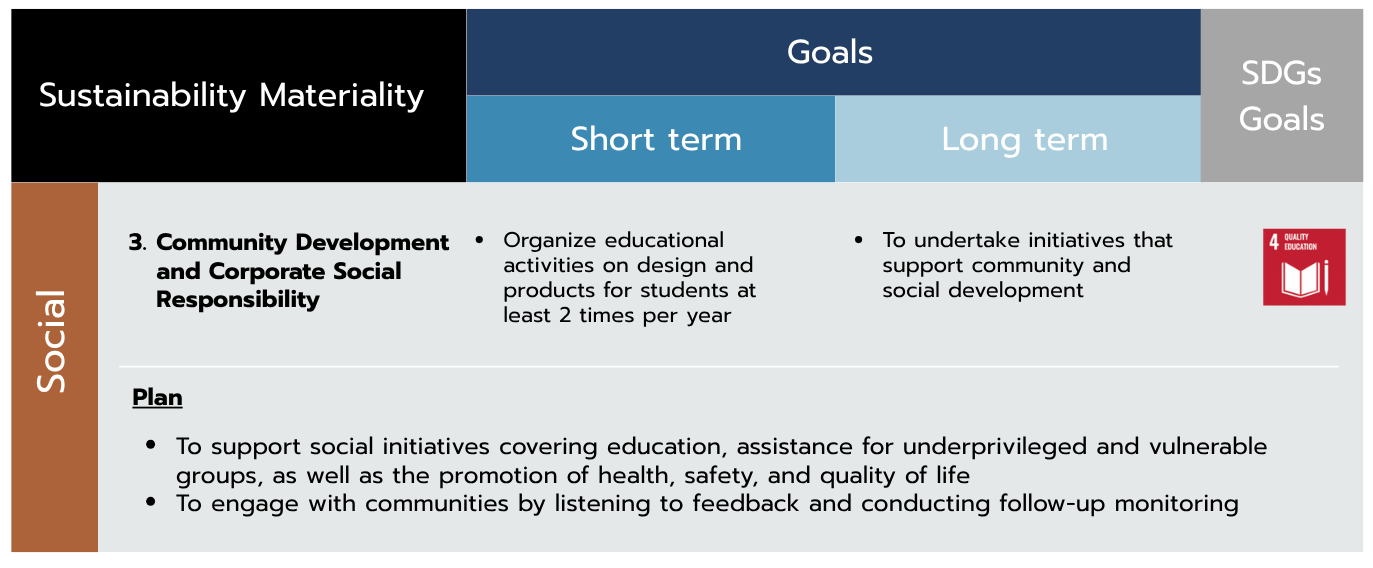
Has Set Community & Social Targets
Yes
Targets
| Indicator | Target Areas | Target Year | Target Year — Description |
|---|---|---|---|
| - | 3037 · Description: Education | 2,025 | - Organize educational activities on design and products for students at least 2 times per year |
Community & Social — Performance & Outcomes
Has Performance Results
Yes
Performance Description
In 2025, the Company implemented a range of activities reflecting its commitment to community and social engagement and development. The Company recognises the importance of fostering positive relationships between its people and the surrounding communities, and carried out the following activities.
1. Euro Creations Open House Programme
On 29 April 2025, the Company organised the Euro Creations Open House, welcoming students from the Bachelor of Industrial Design programme, Department of Industrial Design, Faculty of Architecture, Chulalongkorn University, to visit the Molteni&C Flagship Store (T5) — to explore international design concepts in both Loose Furniture and System Furniture.
The activity enabled students to learn through hands-on experience, gain an understanding of how design knowledge is applied in real-world contexts, and explore the processes of design development and display within a business setting — contributing to the development of professional skills and perspectives among the next generation of designers.
The Company intends to continue building on its collaboration with educational institutions and external organisations through knowledge exchange activities, internships, and seminars, to support the skills development of students and interns in alignment with business needs and promote long-term human resource development.
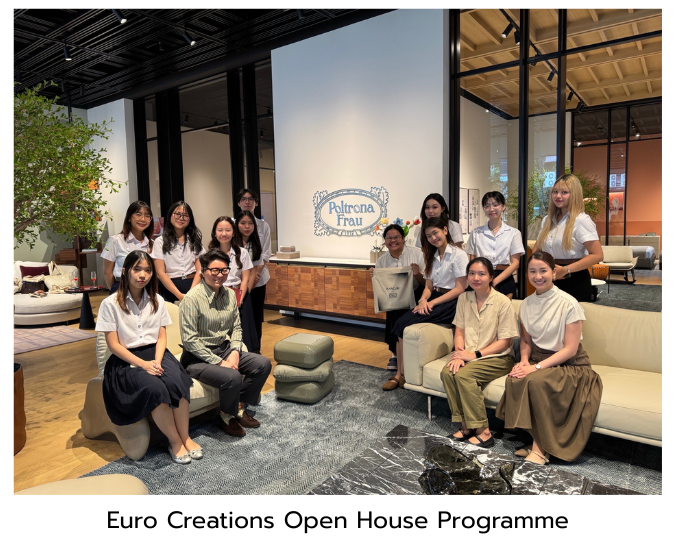
2. Euro Re-Live School Project
Following the flooding that affected communities in the South of Thailand in November 2025 — causing damage and resource shortages at numerous communities and schools — the Company recognised its role in contributing to the recovery and improving the quality of life of children and youth in affected communities, in a manner consistent with its business expertise in "living space and lifestyle design." The Company therefore initiated the Euro Re-Live School Project to support the restoration of learning environments at flood-affected schools.
Under this project, the Company donated five ready-to-use desktop computers and educational materials, with a combined value of Baht 103,810, to Anuban La-ngu School in Satun Province — to enhance educational opportunities and support continuous learning for students.
In addition, the Company invited employees to participate in donating essential items — including cleaning supplies, basic medicines, stationery, children's clothing, bedding, and other necessities — to help alleviate hardship and support the immediate recovery of students and the school.
This project reflects the Company's commitment to applying its expertise and organisational resources for the benefit of society, supporting community development through education, and creating shared value in alignment with the Company's brand image and sustainable business direction.
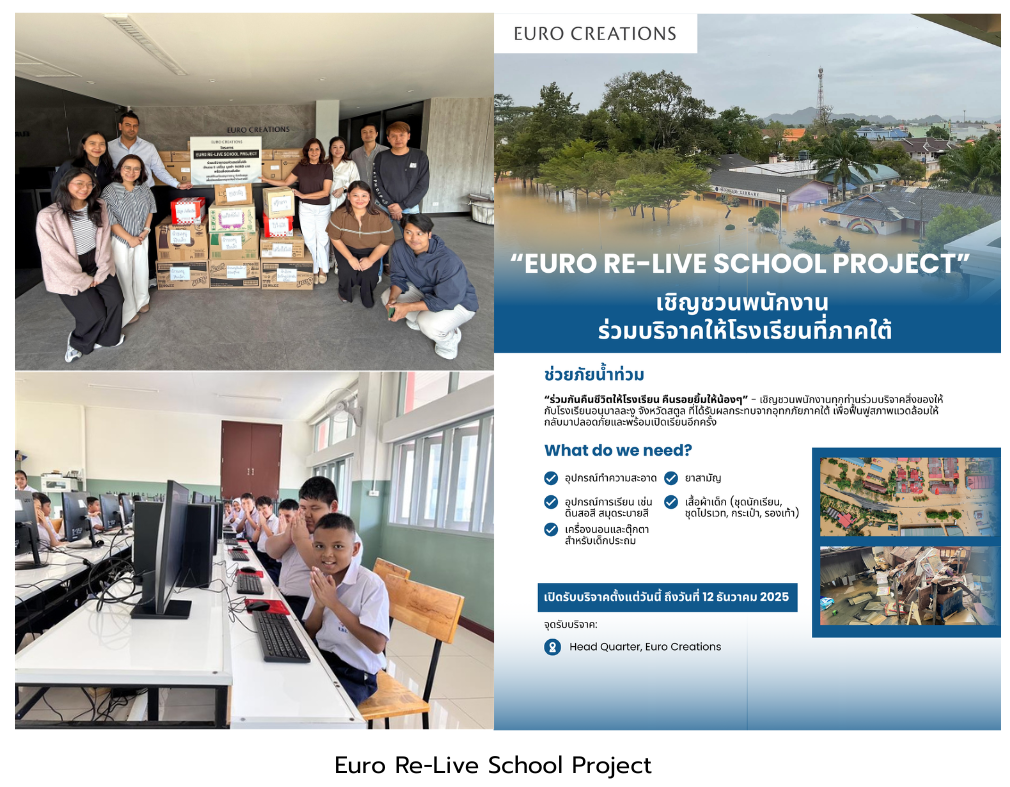
3. Euro X Special Olympics Thailand
The Company places importance on promoting opportunities and improving the quality of life of persons with disabilities and vulnerable groups in society, recognising the role of sport as a powerful tool for developing capabilities, building confidence, and changing societal attitudes towards persons with intellectual disabilities. The Company therefore provides support to the Special Olympics Thailand Association, which is part of the international Special Olympics programme dedicated to promoting equal acceptance and social inclusion.
In 2025, the Company participated in key activities of the Association, including the Special Olympics Thailand CW-X Charity Run 2025, with senior management representatives attending to demonstrate the Company's concrete commitment. The Company also supported the Special Olympics Chao Phraya Dinner Cruise — a welcome reception for participants of the Special Olympics Asia Pacific Leadership Conference attended by representatives from more than 30 countries and approximately 135 participants — with Company management in attendance.
The Company has continuously provided financial support to the Special Olympics Thailand Association over a number of years, alongside support for other related sports organisations, to jointly promote sports development and activities that enhance the quality of life of persons with intellectual disabilities — totalling Baht 170,000 in contributions. This reflects the Company's ongoing commitment to promoting equality, social inclusion, and the sustained improvement of quality of life for persons with disabilities.
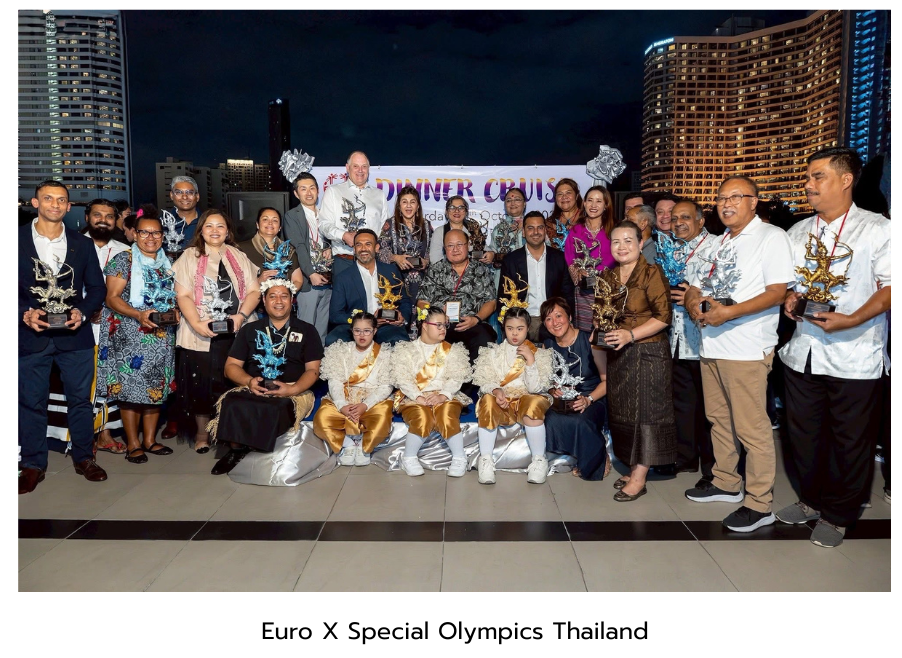
4. Merry Christmas & Happy New Year Project x Babies in Slum Foundation — House of Hope
In 2025, the Company organised a Merry Christmas & Happy New Year internal event on 24 December 2025 to celebrate the festive season and foster positive relationships among employees ahead of the year-end holiday period, while also extending joy and encouragement to children and young people in need of opportunity.
Under this initiative, the Company donated festive cakes to the Babies in Slum Foundation — House of Hope, to bring smiles and warmth to the children in the Foundation's care — a group of underprivileged children requiring special support. This activity reflects the Company's intention to share joy and contribute to improving the quality of life of children and vulnerable groups in society, while instilling a sense of social responsibility among employees and supporting the development of a caring and compassionate society in a sustainable manner.
Law Violation Incidents
Law Violation Incidents
| Metric | Current Year | Previous Year | Two Years Ago |
|---|---|---|---|
| The total number of cases or incidents of significant violations of laws or regulations regarding social and human rights (Cases) | 0 | 0 | 0 |
| The total number of cases or incidents that cause significant labor disputes (Cases) | 0 | 0 | 0 |
| The total number of cases or complaints related to consumer rights violations (Cases) | 0 | 0 | 0 |
| The total number of cases or complaints related to partner rights violations (Cases) | 0 | 0 | 0 |
| The total number of cases or incidents that cause disputes with the community/society (Cases) | 0 | 0 | 0 |
| The total number of cases or incidents related to cyber security or customer data breaches (Cases) | 0 | 0 | 0 |
| The total number of cases or incidents related to safety and occupational health at work (Cases) | 0 | 0 |